
Key takeaway
Some trips need more than a driver — stairs, power wheelchairs, stretchers, escorts. A Massachusetts guide to choosing the right transportation service.
Transportation can become complicated very quickly when someone has limited mobility.
Your mother has a doctor's appointment, but she lives on the second floor and can no longer walk downstairs.
Your father uses a power wheelchair and has ten steps between his front door and the sidewalk.
Your mom has dementia, uses a wheelchair, and you can't leave work every time she has an appointment.
A nursing home needs to send a resident to an outside specialist.
An assisted living facility's regular van isn't available today.
A patient is ready to come home from the hospital but can't get into the family's car.
Someone needs to travel from Worcester to a specialist in Boston.
A patient can't comfortably sit upright and may need non-emergency stretcher transportation.
Or someone has transportation to a procedure but no responsible adult available to accompany them afterward.
These aren't all the same transportation problem.
And they don't all require the same solution.
FedNor Transportation provides private non-emergency transportation and patient-support services throughout Massachusetts for individuals, families, healthcare facilities and organizations dealing with situations like these.
This guide explains the options and, more importantly, what families should consider before arranging the ride.
My Mom Lives on the Second Floor and Can't Walk Downstairs. How Can I Get Her to an Appointment?
This is one of the most important transportation questions families can ask.
Finding a wheelchair-accessible van only solves part of the problem.
The passenger still has to reach the vehicle.
If your mother lives on the second or third floor, cannot safely walk down the stairs, and there is no elevator or accessible ramp, she may need additional mobility assistance before transportation can begin.
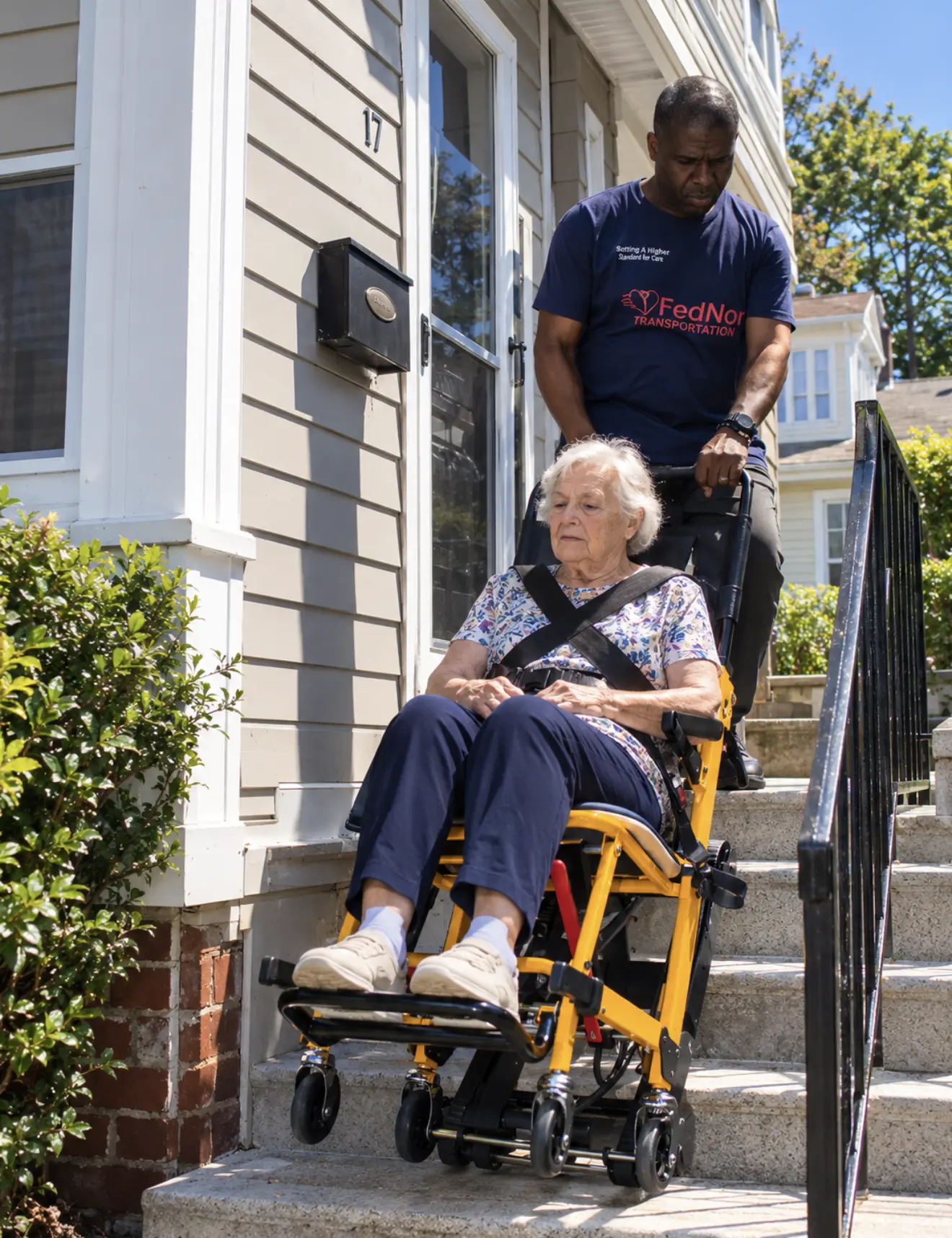
FedNor provides stair-chair assistance by arrangement for appropriate passengers and residences.
When contacting us, don't simply say:
"My mother needs wheelchair transportation."
Tell us:
"My mother is upstairs, cannot walk down the stairs, and needs transportation to a medical appointment."
We need to know about the stairs before arriving.
Tell us approximately how many steps there are, whether they're inside or outside, whether there are landings, where the passenger is located, and what mobility equipment the passenger normally uses.
Not every staircase or passenger can safely be accommodated. The situation must be evaluated based on the passenger, stairs, equipment and staffing required.
But when appropriate, FedNor may be able to solve both sides of the problem: getting the passenger safely out of the residence and providing the transportation.
What If There Are 10 Steps Outside the House?
Exterior stairs can create the same problem.
Imagine that Mom is already sitting in her wheelchair and her doctor's appointment is in an hour.
There are ten steps between the front door and driveway.
There is no wheelchair ramp.
A wheelchair-accessible vehicle arriving in the driveway doesn't solve those ten steps.
That's why it's important to tell your transportation provider about the property before the day of transportation whenever possible.
FedNor can evaluate whether stair-chair assistance can safely be provided and then coordinate the appropriate wheelchair transportation.
The goal is to think about the entire trip:
Inside the home → stairs → vehicle → medical facility → return transportation → stairs → back inside the home.
Not simply the miles between two addresses.
My Dad Uses a Power Wheelchair AND Has Stairs. Can One Company Handle Both?
Potentially, yes.
This is exactly why detailed information matters when requesting transportation.
A passenger may need:
- Stair-chair assistance to exit the residence, followed by
- Power-wheelchair-accessible transportation to the destination
Tell FedNor about both needs during the initial request.
Also tell us what type of power wheelchair is being used.
Power wheelchairs can differ significantly in weight, dimensions and configuration. The transportation provider needs to determine whether the chair can be safely accommodated and secured in the appropriate vehicle.
Don't wait until the vehicle arrives to mention that the passenger uses a large power wheelchair or that there are stairs at the residence.
Can Someone Transport a Tilt-in-Space Wheelchair to a Boston Hospital?
Depending on the chair, passenger and available vehicle, specialized wheelchair transportation may be possible.
A tilt-in-space chair isn't something you should describe simply as "a wheelchair" when booking.
Tell the transportation company exactly what the passenger uses.
If possible, provide information about the chair's dimensions, weight and configuration.
This is particularly important when arranging transportation to major Boston healthcare destinations such as Massachusetts General Hospital, Brigham and Women's Hospital, or Dana-Farber Cancer Institute.
FedNor provides transportation into Boston for appropriate wheelchair and mobility needs, including longer-distance trips originating outside Boston.
Who Can Transport Someone in a Power Wheelchair to a Boston Hospital?
A family may live in Worcester, Marlborough, Framingham, Waltham or another Massachusetts community while receiving specialty care in Boston.
That creates a different transportation problem from a short local ride.
The passenger may need a wheelchair-accessible vehicle for a significant amount of time.
They may use a power wheelchair.
Traffic may affect the trip.
The appointment could last several hours.
And the family needs to determine what happens afterward.
When arranging longer-distance wheelchair transportation, discuss both directions of the trip before leaving home.
Ask:
- How will the patient get there?
- Is the wheelchair appropriate for the available vehicle?
- Are there stairs at home?
- Will someone accompany the passenger?
- Is the return scheduled?
- Will the return be Will Call?
- Does the passenger need the driver to wait?
Those details can matter just as much as the distance.
I Need a Wheelchair Ride From Worcester to Boston. Is Long-Distance Medical Transportation Available?
Yes, private NEMT can be used for longer-distance medical trips when a provider has the appropriate vehicle, staffing and availability.
FedNor provides long-distance non-emergency medical transportation for appropriate trips.
A passenger may need to travel from Central Massachusetts into Boston for specialty care, a procedure, follow-up appointment or treatment.
When requesting a longer trip, provide both complete addresses, appointment time, mobility requirements, wheelchair information, assistance requirements and the anticipated return arrangement.
If the passenger cannot safely travel seated in a wheelchair, tell us that as well.
That leads to another important service.
My Mom Can't Sit Upright in a Wheelchair. Who Can Transport Her?
A wheelchair isn't appropriate for every passenger.
Some non-emergency patients may need stretcher transportation because of their mobility and positioning needs.
FedNor provides private non-emergency stretcher transportation for appropriate passengers, including certain:
- Medical appointments
- Hospital discharges
- Rehabilitation discharges
- Inter-facility transfers
- Long-distance medical trips
The passenger's needs should be discussed before transportation is scheduled so the appropriate equipment and staffing can be determined.
Stretcher NEMT is not emergency ambulance transportation.
If someone is experiencing a medical emergency or needs medical monitoring/intervention during transportation, call 911 or follow the instructions of the treating healthcare provider.
How Do I Get My Mother Home From the Hospital in a Wheelchair?
This is one of the biggest transportation gaps families encounter.
The hospital says:
"Your mother is ready to go home."
That's good news.
Then someone asks:
"How are you getting her home?"
Suddenly the family realizes Mom can't get into the car anymore.
If the patient can safely travel seated in their wheelchair, a wheelchair-accessible NEMT vehicle may be an option.
But don't stop planning at the hospital entrance.
Ask:
- Are there stairs at home?
- Is there a ramp?
- Can the patient get from the vehicle into the residence?
- Has their mobility changed since they entered the hospital?
- What wheelchair are they using?
A successful hospital discharge isn't simply getting the patient out of the hospital.
The transportation plan needs to get them safely to the appropriate destination.
FedNor provides private hospital discharge transportation, including wheelchair and stretcher transportation for appropriate passengers, with additional mobility assistance available by arrangement. Our guide to getting a loved one home from the hospital in a wheelchair walks through the questions to ask before discharge day.
Coming Home From Rehabilitation Can Create the Same Problem
A family member may have entered rehabilitation walking.
Several weeks later, they're ready to come home using a wheelchair.
The family vehicle hasn't changed.
The house hasn't changed.
But the patient's mobility has.
We recently encountered exactly this type of situation: a mother needed to bring her son home from rehabilitation and wasn't sure how she was going to transport him because he was now using a wheelchair.
Families should start discussing transportation before discharge day.
Ask the rehabilitation team what the patient will need.
Then look at the home.
- Are there stairs?
- Is there a ramp?
- Can the wheelchair enter the residence?
- What kind of transportation will be required?
Solving those questions ahead of time can make discharge day significantly easier.
My Mother Has Dementia, Uses a Wheelchair, and I Can't Leave Work. Can Someone Transport Her and Stay With Her?
This is actually two separate needs:
Transportation and appointment support.
Families often combine them mentally, but the services are different.
FedNor provides wheelchair transportation and also offers a Separate Appointment Escort service by arrangement.
An appointment escort may be useful when a family member cannot accompany the passenger.
However, families should understand the limitations.
FedNor's appointment escort is non-clinical support. It does not replace a nurse, home health aide, personal care attendant or medical professional.
For a person living with dementia or another cognitive condition, the family should discuss the person's individual needs with FedNor before booking. Transportation and escort services need to be appropriate for that person's circumstances.
Don't simply say:
"She has dementia."
Explain what assistance she needs during the trip and appointment.
Who Can Take My Mom to Her Medical Appointments When I Can't?
This is one of the most common problems adult children face.
You have a job.
You have children.
You may live an hour away.
Or you may live in another state.
Meanwhile, Mom has cardiology on Monday, physical therapy Wednesday and another appointment Friday.
Families often become the transportation system without realizing it.
Private NEMT can provide another option.
FedNor can provide scheduled transportation for appropriate passengers, including wheelchair and ambulatory transportation.
If your parent also needs someone to accompany them during the appointment, ask separately about appointment escort availability.
I Need a Responsible Adult After a Medical Procedure. Can I Hire Someone?
Possibly—but talk to the medical facility first.
Procedures involving anesthesia or sedation may have specific discharge requirements.
A hospital or surgical center may require a responsible adult to accompany the patient.
The definition of an acceptable escort can vary by facility and procedure.
FedNor offers a Separate Appointment Escort service for appropriate situations, but it is non-clinical and does not automatically satisfy every healthcare facility's discharge requirements.
Before booking:
- Ask the facility exactly what it requires.
- Then explain those requirements to FedNor.
That is especially important for procedures such as colonoscopies, endoscopies and outpatient surgeries.
I Need Transportation After a Colonoscopy Because I Can't Drive. What Can I Do?
Start with the facility.
Ask:
- Can I use professional transportation?
- Do I need someone other than the driver to accompany me?
- Does the responsible adult need to remain at the facility?
- Does someone need to stay with me afterward?
Once you know the rules, transportation can be planned appropriately.
FedNor provides private post-procedure transportation and separate non-clinical appointment escort services by arrangement.
The important thing is to arrange the correct service, not simply a vehicle.
My Mother's Nursing Home Needs Wheelchair Transportation to an Outside Appointment. Who Can We Call?
Nursing homes and skilled nursing facilities don't necessarily provide every outside trip with their own vehicles.
Residents may need transportation to:
- Specialists
- Hospitals
- Imaging centers
- Dental appointments
- Orthopedic appointments
- Wound care
- Dialysis
- Other healthcare facilities
FedNor works with families and facilities arranging private wheelchair, stretcher and ambulatory transportation for appropriate outside appointments.
Facilities should provide accurate mobility information when requesting transportation.
That includes wheelchair type, transfer ability, destination, appointment time, assistance needs and return arrangements.
Our Assisted Living Facility Needs a Wheelchair Van Today. Are Last-Minute Trips Possible?
Sometimes.
FedNor accepts same-day and last-minute transportation requests based on availability.
But same-day availability cannot be guaranteed.
The earlier the facility calls, the better.
Have the information ready:
- Passenger name
- Pickup location
- Destination
- Appointment time
- Wheelchair type
- Transfer ability
- Stairs or accessibility issues
- Escort requirements
- Return plan
Last-minute transportation becomes much easier to evaluate when dispatch receives complete information immediately.
My Assisted Living Facility Can't Provide a Ride Today. Who Can Transport Me?
A facility's regular transportation schedule may already be full.
The facility vehicle may be unavailable.
Or the passenger may require a type of transportation the facility doesn't provide.
Private NEMT may be another option.
FedNor accepts private-pay transportation requests from individuals, families, healthcare facilities and organizations.
Same-day requests are evaluated based on the required vehicle, staffing, equipment, pickup location, destination and existing schedule.
What If My Insurance Transportation Isn't Available?
Private-pay transportation is another option.
You don't necessarily need to have transportation benefits through an insurance program to hire a private NEMT provider.
FedNor accepts private-pay transportation.
This can be useful when:
- Your insurance transportation isn't available.
- The trip isn't covered.
- You need a service outside the covered benefit.
- You need specialized mobility assistance.
- You want to arrange transportation directly.
- Or a family or organization is paying for the trip.
If you have transportation benefits available through insurance or a public program, however, it is worth checking those benefits before paying privately.
FedNor does not currently provide or bill MassHealth PT-1 transportation directly.
What About MassHealth Members Who Can't Get Out of the House?
This distinction is important.
Someone may already have transportation arranged through their eligible benefit but still be concerned about physically reaching the pickup location.
MassHealth members should first tell their healthcare provider and transportation program about their mobility needs and determine what assistance may be available through their benefit.
FedNor can separately evaluate private mobility assistance, including stair-chair assistance in appropriate situations.
That private service is separate from the person's MassHealth transportation benefit.
Don't cancel transportation you already have simply because stairs are a problem.
First determine what your existing program can provide.
Then determine whether additional private assistance is necessary.
Who Provides Recurring Wheelchair Transportation for Dialysis, Physical Therapy or Wound Care?
Not every transportation need is a one-time event.
Dialysis may occur several times each week.
Physical therapy can continue for weeks or months.
Patients may also have recurring:
- Radiation treatment
- Chemotherapy
- Infusions
- Wound care
- Rehabilitation
- Specialty treatment
- Follow-up appointments
When the schedule is predictable, arranging recurring transportation or a standing order can be much easier than booking every ride individually.
FedNor provides recurring private transportation schedules based on availability.
Give us the treatment days, pickup time, appointment time, mobility requirements and expected duration.
Can FedNor Take Someone Somewhere Other Than a Medical Appointment?
Yes.
Accessible transportation needs don't disappear when the doctor's appointment ends.
Someone who uses a wheelchair may still want to attend:
- Church
- A wedding
- A funeral
- A family gathering
- A holiday celebration
- A social outing
FedNor provides private accessible transportation for appropriate non-medical trips as well.
For an older adult or person with limited mobility, transportation can mean more than healthcare.
It can mean continuing to participate in family and community life.
What Medical Transportation Services Does FedNor Provide?
Depending on the passenger's needs, trip requirements and availability, FedNor Transportation provides:
- Wheelchair transportation
- Power wheelchair transportation
- Bariatric wheelchair transportation
- Tilt-in-space wheelchair transportation when appropriately accommodated
- Non-emergency stretcher transportation
- Stair-chair assistance
- Ambulatory transportation
- Door-through-door transportation
- Senior transportation
- Hospital discharge transportation
- Rehabilitation center transportation
- Medical appointment transportation
- Dialysis transportation
- Chemotherapy transportation
- Radiation treatment transportation
- Infusion transportation
- Physical therapy transportation
- Wound-care transportation
- Post-surgery transportation
- Appointment escort services
- Long-distance medical transportation
- Inter-facility transportation
- Same-day transportation based on availability
- Last-minute transportation based on availability
- Recurring and standing-order transportation
- Church transportation
- Family and social-outing transportation
- Wedding transportation
- Funeral transportation
- Holiday transportation
The Most Important Question Isn't "Do You Have a Van?"
It's:
"What does this passenger actually need from the moment they leave their room until they reach their destination?"
That's the question families should think about.
A wheelchair van doesn't solve stairs.
A stretcher doesn't automatically mean someone needs an ambulance.
A ride home after sedation doesn't automatically satisfy an escort requirement.
A transportation company arriving at a nursing home doesn't help if nobody communicated that the resident uses a large power wheelchair.
And a hospital discharge isn't completely planned if everyone knows how Mom gets to the house but nobody knows how she gets inside the house.
Good non-emergency medical transportation starts with understanding the entire passenger journey.
Need Help Figuring Out the Right Transportation?
You don't necessarily need to know the transportation terminology before calling FedNor.
You don't need to determine by yourself whether you should ask for a wheelchair vehicle, stair chair or another appropriate service.
Tell us the situation.
For example:
"My mother is coming home from rehab tomorrow. She now uses a wheelchair, there are eight stairs outside the house, and I don't know how I'm going to get her inside."
Or:
"My father can't comfortably travel sitting upright and needs to get to an appointment."
Or:
"My mother has a wheelchair and I can get her to the appointment, but I can't leave work to stay with her."
Or:
"Our assisted living resident needs transportation today and our facility vehicle isn't available."
Those details allow us to understand the problem you're actually trying to solve.
You can submit your trip details through our ride request page, and we'll follow up with a quote when we're able to accommodate the trip. You can also call us directly at 781-552-4559.
FedNor Transportation
Non-Emergency Medical & Accessible Transportation
For medical emergencies, call 911.
Need a ride you can trust?
FedNor Transportation provides safe, dignified non-emergency medical transportation across MetroWest Massachusetts.