
Key takeaway
The hospital says Mom is ready to go home, but she can't get into the family car anymore. Here is what actually matters when arranging wheelchair transportation after a discharge.
There is a particular kind of phone call we hear all the time.
A mother or father is being discharged from the hospital. They can't get into the family car the way they used to. Maybe they're using a wheelchair now. Maybe they were using one before they went into the hospital. Maybe they can no longer comfortably sit upright and need to travel by stretcher.
The son or daughter gets on the phone and starts calling transportation companies. And one of the first questions is usually very simple: "Do you transport people in wheelchairs?" Yes. But after answering thousands of transportation calls, I've learned that the wheelchair is rarely the only thing we need to talk about.
- There might be stairs at home.
- Mom might not have her own wheelchair.
- The wheelchair might be much larger than expected.
- She may not be able to transfer.
- The hospital might say she's ready right now.
- The family might be at work.
And sometimes the person making the call has never arranged medical transportation in their life. That's the part people don't always see. For those of us who do this every day, terms like wheelchair transportation, ambulatory transportation, stretcher transportation and stair-chair assistance are normal. For the person calling? This might be their first time hearing any of them.
So if you're trying to figure out how to get your mother, father, spouse or another loved one home from the hospital, this is for you. You don't need to know everything. You just need to know what information matters.
Start With What Your Loved One Needs Today
Don't worry about knowing the transportation terminology. Start with your loved one.
- Can Mom walk to a regular vehicle and get into the seat?
- Will she be traveling in a wheelchair?
- Does she use a power wheelchair?
- Can she transfer out of the wheelchair?
- Is she unable to comfortably travel seated and already requires stretcher transportation?
Those are much more useful details than simply saying: "I need medical transportation." When someone calls us about a discharge, some of the first things we want to know are: What time is the discharge? Which hospital is she leaving? Where is she going? Is she ambulatory, traveling by wheelchair, or traveling by stretcher?
And then there is one question that I wish came up much earlier in the discharge conversation: Are there stairs at home? It sounds like a small detail. It isn't.
Don't Just Plan the Ride. Plan the Front Door.
One of the easiest mistakes to make is concentrating completely on transportation from the hospital to the house. The family finds a wheelchair-accessible vehicle. Problem solved. Except the vehicle arrives at the house and there are ten steps to the front door. Or Mom lives on the second floor. Or there is no ramp.
Now there is another transportation problem that nobody planned for. We've had situations where the passenger arrived home and only then did we learn about the stairs. At that point, our driver has to contact the office and we have to see whether we can dispatch additional staff and stair-chair equipment. That means another service, additional cost, and potentially additional waiting.
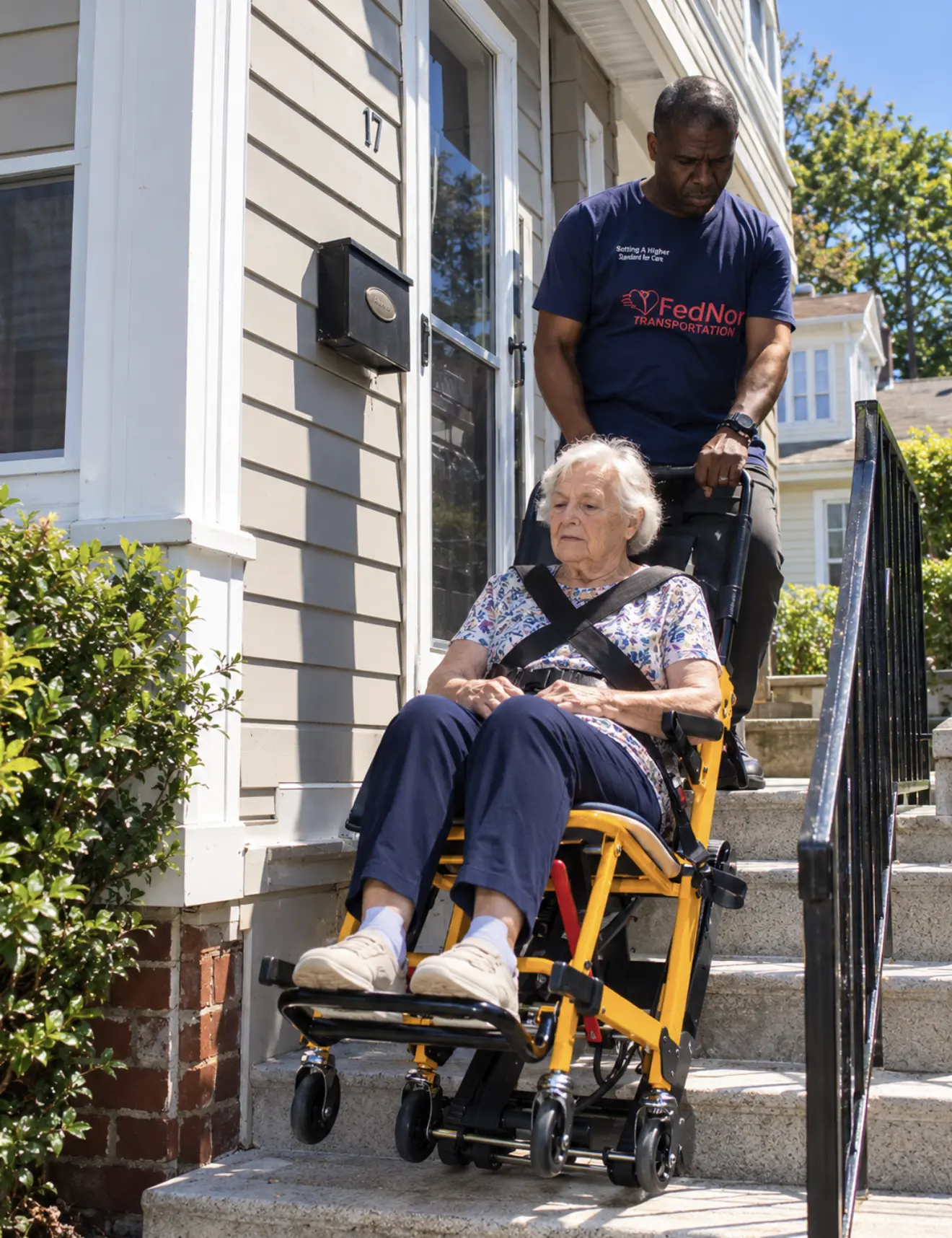
It's much easier when we know beforehand. That's why one of the first things I ask is: "Are there any stairs at the home?" And it's one question I wish every discharge planner, nurse, family member and transportation coordinator thought about before discharge transportation was arranged. Because getting someone to the address isn't necessarily the same thing as getting them where they need to be. Our patient support services page explains how stair-chair assistance works and when it can be added to a trip.
"Wait... The Wheelchair Goes Inside the Van?"
Yes. This is another question we hear more than you might expect. People sometimes call asking about wheelchair transportation and then ask whether the wheelchair actually goes inside the vehicle. That's a perfectly reasonable question when you've never used the service before.
A wheelchair-accessible vehicle is designed so that an appropriate wheelchair and passenger can travel in the vehicle, with the wheelchair properly secured for transportation. The passenger doesn't necessarily have to get out of their wheelchair and somehow climb into a regular car seat. For families doing this for the first time, even understanding that can be a relief. There are no stupid questions when you've never had to arrange this before.
Tell the Transportation Company What Kind of Wheelchair Mom Uses
This is one of the details families forget most often. People say: "She's in a wheelchair." But wheelchairs aren't all the same. There are standard manual wheelchairs, power wheelchairs, bariatric chairs, reclining wheelchairs, tilt-in-space chairs and other configurations. Size matters.
If someone uses a larger wheelchair, don't assume that saying "wheelchair" gives the transportation company everything it needs to know. Tell them what kind it is. If you're unsure, say that. A good transportation company should ask questions rather than guess. The point isn't to make booking complicated. It's the opposite. Getting the right information beforehand prevents surprises when the vehicle arrives.
What If Mom Doesn't Own a Wheelchair?
Ask. Don't assume that a wheelchair transportation company automatically provides a wheelchair with every trip. At FedNor, for example, a wheelchair can be provided when arranged as an additional service and an additional charge applies. Other providers may handle this differently.
So if the hospital has been using its wheelchair to move Mom around but she doesn't actually own one, mention that when arranging transportation. It's much better to have that conversation before the vehicle arrives.
What If Mom Was Walking Before She Went Into the Hospital?
This happens too. Someone enters the hospital ambulatory. By the time they're leaving, their mobility status has changed. From a transportation standpoint, that's important. The ride that would have worked before hospitalization might not be the ride they need today.
If the passenger is now traveling by wheelchair, tell the transportation provider. The booking can be changed from ambulatory transportation to the appropriate wheelchair service when possible. Don't book based on how Mom used to travel. Book based on how she needs to travel now.
And when it comes to whether she is medically ready for discharge, what equipment she should use at home, or what level of care she needs after discharge, those are questions for her healthcare team. We're the transportation people. We don't make that medical decision.
"She's Ready Right Now. Can You Come?"
We hear this one a lot. Sometimes transportation hasn't been arranged beforehand. Then the hospital says the patient is ready to leave. Everybody starts calling. The family is trying to figure out what kind of vehicle they need, how much it costs, and who can actually come. And suddenly something that should be a happy moment — Mom is going home — becomes stressful.
We try to accommodate these calls whenever we can. But there is an important reality with last-minute transportation: the appropriate vehicle or crew may already be transporting someone else. Sometimes we're able to respond quickly. Sometimes we're extremely busy and the family has to wait until the appropriate vehicle becomes available.
That's why, whenever possible, start thinking about transportation before the moment someone says: "She's ready now." You don't necessarily need to know the exact minute of discharge days in advance. But knowing that wheelchair or stretcher transportation will probably be needed gives you a head start.
And Sometimes the Opposite Happens
The transportation is booked. The driver arrives. But the patient isn't ready. Hospital discharge times can change. Paperwork isn't finished. Someone is waiting for medication. A final step hasn't been completed.
From the family's perspective, that's part of leaving the hospital. From the transportation company's perspective, however, a vehicle and driver have now arrived for a scheduled trip and are waiting. Providers handle waiting differently. With our service, there are situations where we have no choice but to wait, but once the wait extends beyond the included period, additional waiting charges may apply.
So when you're given a discharge time, it's worth asking whether that's the time transportation should actually arrive or simply the anticipated discharge time. You don't need a perfect answer. You just want the best information available.
"I Can Get Her Home. I Just Can't Get Her Upstairs."
This is another call we receive. And it's important because the family may not need transportation at all. They have the vehicle. They can drive Mom home. Their problem is the stairs.
In appropriate situations, a family can arrange stair-chair assistance as a standalone service. That means you don't necessarily have to purchase transportation you don't need just to get help at the residence. You can explain: "I can bring my mother home myself. I need help getting her upstairs." Then the provider can determine whether the staircase, passenger and circumstances are appropriate for stair-chair service.
For many families, they don't even know a service like this exists. We've had people watch our team use stair-chair equipment and tell us afterward that they had never seen anything like it. You can hear the relief. The family had been looking at those stairs thinking: How are we going to do this? Now they know there may be another option.
But Stair-Chair Assistance Isn't Something to Improvise
Tell the provider about the stairs. Don't wait until arrival. How many are there? Are they inside or outside? Are there turns or landings? Is the staircase unusually narrow? What are the passenger's mobility circumstances?
Transportation professionals need to determine what they can safely do. And there are limits. For example, there are forms of hands-on patient care that are outside the role of a transportation company. A transportation provider shouldn't pretend to be a nurse, physical therapist or medical professional. Sometimes helping means clearly saying: "That part isn't something we're permitted or equipped to do." Safety matters more than saying yes to everything.
What If Mom Can't Travel Sitting in a Wheelchair?
Then don't try to force a wheelchair ride to work simply because it seems like the obvious transportation option. Some patients already know they cannot travel seated and need non-emergency stretcher transportation. In our experience, families usually understand this before calling or explain the patient's situation, and we can discuss what type of transportation they are requesting.
If you're uncertain about how your loved one can safely travel, talk with the healthcare professionals caring for them. A transportation company can explain the transportation services it provides. It shouldn't diagnose the patient or decide whether someone is medically safe for discharge. Again: we're the transportation people. That's an important boundary.
Families Often Ask About Price First
Of course they do. Healthcare is expensive. Transportation can be expensive. Some families are hoping insurance will pay. Hospital staff and case managers are often trying to find covered transportation or the most affordable appropriate option for the patient. Those are real concerns.
But when a family calls me, sometimes everyone is so focused on "How much does it cost?" that the more important transportation questions haven't been answered yet. Before comparing prices, make sure you're comparing the right service. A cheaper wheelchair ride isn't helpful if Mom can't get from the driveway into the house. A regular vehicle isn't useful if she can't transfer into it. A wheelchair vehicle isn't the right comparison if she actually needs stretcher transportation. Our guide on how medical transportation pricing works explains why the right answer depends on the whole trip.
So yes, ask about price. You absolutely should. But also ask: What exactly does Mom need to get from where she is now to where she needs to be?
The Adult Children Making These Calls Are Often Overwhelmed
This is probably the part I've become more aware of after answering so many calls. Sometimes the person on the other end isn't confused because the process is particularly complicated. They're confused because this has never happened to their family before.
Yesterday, Mom was independent. Now they're discussing wheelchairs. Or Dad has always been the one who handled everything himself. Now his wife is trying to figure out how to get him home, and she physically can't manage his wheelchair. An adult child may be trying to arrange the whole thing while they're at work. Some live far away. Some have never heard the words "non-emergency medical transportation" before that day.
And sometimes you can hear the frustration immediately. We've had people essentially tell us: "This is too much for me. I would really appreciate it if you could help." That's when the job becomes less about transportation terminology and more about slowing the conversation down. Where is your loved one? Where are they going? How are they traveling? Do they use a wheelchair? What kind? Are there stairs? Do they need transportation, stair assistance, or both? Let's figure out what you're actually trying to arrange. One question at a time.
You Don't Need to Know How This Industry Works
This is something I wish more caregivers knew. If this is the first wheelchair ride you've ever arranged, we don't expect you to talk like a transportation coordinator. You don't need to know all the terminology. You don't need to know which vehicle we use. You don't need to understand securement equipment. You don't need to know whether what you're describing has a particular industry name.
Tell us what's happening. "My mom uses a wheelchair." "She can't transfer." "There are eight stairs outside." "She doesn't own a wheelchair." "She's being discharged around 3." "I can drive her home, but I can't get her upstairs." "She can't sit upright for the trip." Those statements are incredibly useful. We can ask the transportation questions from there.
If I Could Add One Question to Every Discharge Conversation
It wouldn't be: "Do you have a ride?" It would be: "Are there any stairs at your home?" Because "yes, we found a wheelchair van" doesn't necessarily mean the transportation problem is solved. There is a whole journey between the hospital room and Mom being safely back where she needs to be. Transportation companies see the pieces of that journey that families sometimes don't think about until the vehicle pulls into the driveway. And that's why details matter.
A Simple Checklist Before You Book the Ride Home
You don't need a complicated discharge transportation checklist. Start with these:
- Where is the patient being picked up?
- What time is discharge expected?
- What is the complete destination address?
- Is the passenger ambulatory, traveling by wheelchair, or traveling by stretcher?
- If using a wheelchair, what type and approximate size is it?
- Does the passenger have their own wheelchair?
- Can the passenger transfer, if a transfer would be required?
- Are there stairs at the destination?
- Is there a wheelchair ramp or elevator?
- Does the family need transportation, stair-chair assistance, or both?
- Who should the transportation company contact if something changes?
- Is the quoted service exactly what the passenger needs?
You may not know every answer. That's okay. The point is to discover the questions before discharge becomes an emergency in everyone's mind.
If You're Reading This While Trying to Get Mom Home Today
First, don't feel like you were supposed to already know all of this. Most people don't learn how wheelchair transportation works until someone they love suddenly needs it. Call the appropriate transportation providers and explain the situation plainly.
If you're calling FedNor, our booking process is intentionally straightforward. You can submit the transportation information through our ride request page, and we'll review the request and send a quote by email when we're able to accommodate the trip. You can then review the details before confirming.
But whether you use us or another appropriate provider, remember the most useful information you can give them: Where is Mom? Where is she going? When is she expected to leave? How does she need to travel? What kind of wheelchair does she use? And are there stairs when she gets home?
That last question might save everyone a lot of stress. Because sometimes the hardest part of getting Mom home isn't the drive from the hospital. It's the last ten steps.
Need a ride you can trust?
FedNor Transportation provides safe, dignified non-emergency medical transportation across MetroWest Massachusetts.