
For many families, transportation is something they do not think much about until it suddenly becomes a problem.
A person has a medical appointment. A family member needs to get to a hospital. Someone who normally drives can no longer do so. A parent uses a wheelchair. A patient lives in a home with stairs. A power wheelchair is too large for an ordinary vehicle. An older adult needs help getting from the front door to the vehicle.
That is when a simple question like "How are we getting there?" can become a surprisingly complicated problem.
In the Greater Boston area, families have access to many transportation options, but those options are not interchangeable. A standard rideshare vehicle is not the same thing as wheelchair accessible transportation. A wheelchair van is not the same thing as stair chair assistance. A medical transportation company is not necessarily equipped to handle every type of mobility device.
Understanding the difference before the day of the trip can prevent delays, failed pickups, unnecessary transfers, and a great deal of stress for the passenger and the people trying to help them.
FedNor Transportation works with passengers who need wheelchair transportation, accessible transportation, ambulatory transportation, stretcher transportation, and stair chair assistance in Massachusetts. One of the most important lessons we have learned is that the transportation vehicle is only one part of the equation.
The real question is whether the entire trip can be completed safely and appropriately from the passenger's starting point to the final destination.
What Does “Accessible Transportation” Actually Mean?
People often search for terms such as "ADA transportation near me" or "accessible transportation near me" when what they really need is a vehicle and transportation service that can accommodate their particular mobility situation.
The Americans with Disabilities Act recognizes wheelchairs and certain other mobility devices as important tools for people with disabilities. Federal ADA requirements address accessibility in public transportation and also establish requirements concerning mobility devices and transportation services in specific circumstances.
However, the phrase "ADA transportation" does not automatically tell you what kind of vehicle will arrive at your home. That distinction matters.
A passenger using a manual wheelchair may have very different transportation needs from someone using a large power wheelchair. Someone who can transfer from a wheelchair into a vehicle seat may have different needs from someone who must remain in their wheelchair during transportation.
Someone who lives on the first floor may have a straightforward accessible pickup. Someone who lives at the top of a flight of stairs may need an entirely different plan.
The most useful question is therefore not simply, "Do you provide ADA transportation?" A better question is, "Can you accommodate my specific mobility device and the conditions at my pickup location?" That question gives the transportation provider the information needed to determine whether the trip can actually be accommodated.
Wheelchair Transportation Is More Than Having a Wheelchair Van
A wheelchair accessible vehicle is designed to allow a wheelchair passenger to enter and travel in a vehicle without requiring the passenger to transfer into a standard passenger seat. But there are several details that should be discussed before booking.
The transportation provider may need to know whether the passenger uses a manual wheelchair, power wheelchair, mobility scooter, or another mobility device. For a power wheelchair, the dimensions and weight of the chair can be particularly important. Two power wheelchairs can look completely different and have very different transportation requirements.
- The approximate width and length of the wheelchair
- Whether the wheelchair folds
- Whether the passenger can transfer to a vehicle seat
- Whether the passenger will remain in the wheelchair during the ride
This is not about making the booking process unnecessarily complicated. It is about avoiding the situation where a vehicle arrives and the passenger's mobility device cannot be accommodated.
A transportation provider that asks detailed questions before the trip is not necessarily making the process harder. In many cases, those questions are exactly what should happen before the vehicle is dispatched.
What Is Chair Car Transportation?
Another phrase people encounter when searching for medical transportation is "chair car transportation." The terminology can be confusing because different transportation programs and companies may use terms differently.
In general conversation, people may use "chair car" to describe transportation for a person who is ambulatory or who can transfer from a wheelchair into a passenger seat, while wheelchair transportation generally refers to transportation where the passenger remains in their wheelchair during the trip. That distinction should always be confirmed with the transportation provider.
If someone tells a transportation company, "My mother uses a wheelchair," that does not necessarily answer the most important question. The provider needs to know whether she can safely transfer from the wheelchair to a vehicle seat. If she cannot transfer, the vehicle needs to accommodate her wheelchair. That single detail can completely change the type of transportation required.
The Problem Nobody Thinks About Until the Driver Arrives: Stairs
This is one of the biggest gaps in transportation planning. A family may successfully arrange a wheelchair accessible vehicle and assume the transportation problem is solved.
Then the driver arrives. There are six steps from the front door to the driveway. The passenger cannot safely walk down them. The wheelchair cannot simply be carried down the stairs. The family members are not trained or equipped to move the passenger. Now the accessible vehicle is sitting outside, but the passenger still cannot get from the house to the vehicle.
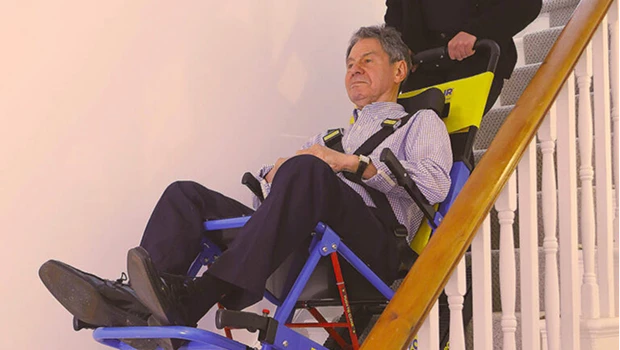
This is where stair chair assistance can become an important part of the transportation plan. A stair chair is designed to assist with moving a person up or down stairs in situations where using the stairs normally is not safe or practical. The specific equipment, procedures, staffing, and circumstances under which assistance can be provided vary by transportation provider.
That is why families should discuss stairs before booking. Do not wait until the vehicle arrives.
- If the passenger lives in a house with stairs, tell the transportation company
- If there is a narrow staircase, tell them
- If there are outdoor steps, tell them
- If the passenger cannot stand or walk, tell them
- If there is a landing, tight turn, or steep staircase, explain it
A transportation company cannot properly plan for a situation it does not know about.
“Wheelchair Transportation Near Me” Is Only the Beginning of the Search
A Google search for "wheelchair transportation near me" may produce a long list of companies. The challenge is determining which company actually fits the passenger's needs. Families should look beyond the words "wheelchair transportation" and ask specific questions.
- Can the passenger remain in their wheelchair during the ride?
- Can the vehicle accommodate a power wheelchair?
- What are the vehicle's weight and dimensional limitations?
- Does the provider offer stair chair assistance?
- Can the provider handle pickup from a home with stairs?
- Is the transportation direct, or will the passenger be transferred between vehicles?
- Does the company provide transportation for appointments, hospital visits, rehabilitation, dialysis, or other recurring needs?
- What information does the company need before confirming the trip?
These questions can save a family from making a booking based on a service description that sounds appropriate but does not actually match the passenger's circumstances.
Why the Pickup Location Matters as Much as the Destination
When people book transportation, they often focus almost entirely on where they are going. The pickup location can be just as important.
Consider two passengers going to the same Boston medical facility. Passenger A lives in an apartment building with an elevator and a level entrance. Passenger B lives in a home with a wheelchair accessible vehicle parked in the driveway, but there are eight stairs between the front door and the driveway. They have the same destination. They do not have the same transportation requirements.
This is why a good transportation assessment begins at the pickup location. Families should think through the entire route.
- Where is the passenger starting, and can they get to the front door?
- Are there stairs, or is there an elevator?
- Is the entrance wide enough? Is there a steep walkway?
- Is there a safe place for the vehicle to park?
- Can the passenger remain in the wheelchair, or does the wheelchair need to be moved separately?
- Are there facility procedures the driver needs to follow?
These details become especially important when transporting older adults and people with significant mobility limitations.
Transportation to Medical Appointments Is Not the Only Use
Accessible transportation is often associated with hospitals and doctors' appointments. Those trips are certainly important. But people who use wheelchairs also need to participate in ordinary life.
They visit family. They attend birthdays, restaurants, community events, religious services, and shopping trips. They visit friends. They travel to rehabilitation appointments. They may need transportation to work or other activities.
A mobility limitation does not eliminate the need to participate in everyday life. Reliable wheelchair transportation can therefore be about much more than getting someone to a medical appointment. It can be about helping someone maintain a connection to the people and places that matter to them.
Boston's Transportation Environment Makes Planning Important
The Greater Boston area presents its own transportation challenges. Older buildings, narrow entrances, multi level homes, apartment buildings, busy streets, limited parking, and complicated facility layouts can all affect how a wheelchair passenger gets from a doorway into a vehicle and from the vehicle into the destination.
A family may also be coordinating several people at once. The passenger may need to be ready at a specific time. A caregiver may need to provide paperwork. A facility may need to know that transportation is arriving. A family member may need to meet the driver at the destination.
When several pieces have to line up, transportation planning becomes much more important than simply putting an address into a rideshare application.
What Should a Family Tell the Transportation Company?
The more accurately the transportation provider understands the situation, the better the chance of arranging the appropriate service. Before calling, have the following information available.
- The passenger's mobility status and the type of wheelchair or mobility device
- Whether the passenger can transfer, stand, or walk even a short distance
- The approximate size of the wheelchair
- The passenger's approximate weight if relevant to equipment or vehicle capacity
- The pickup address and the destination address
- Whether there are stairs at the pickup location or the destination
- Whether an elevator is available
- Whether a caregiver will be present
- Whether someone will meet the passenger at the destination
- Whether there are facility specific pickup procedures
This information does not need to be presented perfectly. The goal is simply to give the transportation provider an accurate picture of what the trip involves.
What About Power Wheelchairs?
Power wheelchairs deserve special attention because they can vary substantially in size, weight, and configuration. A transportation provider should not assume that every power wheelchair will fit the same way in every accessible vehicle.
Families should provide accurate information about the chair before the trip. If the wheelchair has unusual dimensions, a large base, extended footrests, specialized seating, or other features that affect its size, mention those details. If the passenger will remain seated in the power wheelchair during transportation, say so. If the passenger can transfer and the wheelchair can be transported separately, explain that as well.
The objective is not simply to find a vehicle that is technically accessible. The objective is to arrange transportation that matches the passenger and their actual mobility equipment.
Why “Same Day” Does Not Always Mean “Instantly Available”
Medical transportation needs do not always happen according to a perfect schedule. Appointments are rescheduled. Discharges happen unexpectedly. Family plans change. A patient may suddenly need transportation home. Transportation companies may receive a high volume of requests at the same time.
For that reason, families should provide as much notice as possible when transportation is important. This is especially true when the trip requires a specific accessible vehicle, stair chair assistance, stretcher transportation, or other specialized arrangements.
A last minute request may sometimes be accommodated, but availability cannot be assumed. Calling early gives the provider more opportunity to understand the request, verify the appropriate vehicle, and coordinate the pickup.
What Families Should Ask Before Booking
A transportation company should be willing to answer reasonable questions about the trip. Here are some questions worth asking.
- Will my mother remain in her wheelchair during transportation?
- Can your vehicle accommodate her power wheelchair?
- She has stairs at the front entrance. Can you accommodate that?
- Do you provide stair chair assistance?
- What information do you need about the wheelchair?
- Will the ride be direct? Can a family member accompany her?
- What happens if the appointment runs late, or the facility changes the pickup time?
- Where should the passenger wait, and what happens when the driver arrives?
These are not excessive questions. They are practical questions. The goal of accessible transportation should be to make the trip predictable rather than leaving the family to solve problems after the vehicle arrives.
What “Reliable Transportation” Should Actually Mean
Reliability is more than showing up at the right address. For a wheelchair passenger, reliability also means understanding the transportation requirements before the pickup.
A vehicle arriving on time is not helpful if it cannot accommodate the passenger. A wheelchair accessible van is not enough if nobody knows there are stairs at the entrance. A driver arriving at a facility is not enough if the facility staff were never told that the passenger was being picked up.
Good transportation planning considers the entire trip. That includes the passenger, the mobility device, the pickup environment, the vehicle, the driver, the destination, and the people responsible for receiving the passenger.
A Better Way to Search for Medical Transportation
Instead of searching only for "medical transportation near me," families can search based on the actual need.
- Wheelchair transportation near me
- Wheelchair transportation Massachusetts
- Accessible medical transportation
- ADA transportation near me
- Chair car transportation
- Stair chair assistance near me
- Wheelchair transportation with stairs
- Stair chair transportation Massachusetts
These searches can help a family identify providers that discuss the specific service they need. But the search results should be the beginning of the process, not the end. Once a company is identified, call and explain the actual situation.
The most useful transportation company is not necessarily the one with the longest list of services on its website. It is the company that understands what you are actually asking for and can tell you whether the trip can be accommodated.
Accessible Transportation Is a Community Issue
The conversation around transportation accessibility is often framed as a medical issue. It is also a community issue. A person cannot fully participate in a community if they cannot physically reach the places where that community exists.
Transportation affects access to healthcare, employment, education, family gatherings, restaurants, entertainment, shopping, and social connections. For caregivers, transportation can also affect work schedules and family responsibilities.
A daughter may need to take time away from work to drive a parent to an appointment. A son may live in another city and be unable to provide transportation. A spouse may no longer be comfortable driving. A caregiver may not have access to an appropriate vehicle. A person may own a wheelchair accessible vehicle but have nobody available to drive it.
These are transportation problems, but they are also everyday life problems. That is why accessible transportation deserves to be treated as an important part of mobility and independence.
The Most Important Conversation Should Happen Before the Ride
If there is one lesson families should take away from all of this, it is simple. Do not wait until the driver arrives to explain the difficult part of the trip.
- If there are stairs, say so
- If there is a power wheelchair, say so
- If the passenger cannot transfer, say so
- If the passenger needs to remain in the wheelchair, say so
- If the destination has a complicated entrance, say so
- If someone needs to meet the passenger at the destination, arrange that ahead of time
The more information a transportation provider has before the trip, the better positioned they are to determine what can actually be provided.
FedNor Transportation and Accessible Transportation in Massachusetts
At FedNor Transportation, we understand that every wheelchair transportation request starts with a person, not simply an address.
A passenger may be leaving a home with stairs. They may be using a manual wheelchair or a power wheelchair. They may need wheelchair accessible transportation to a medical appointment, ambulatory transportation, stretcher transportation, or stair chair assistance to get safely from a home to an accessible vehicle.
The transportation plan needs to reflect the passenger's actual circumstances. That is why we encourage families and caregivers to tell us about the situation before the ride is scheduled. The more we understand about the passenger, the mobility device, the pickup location, and the destination, the better we can determine what transportation arrangement is appropriate.
Accessible transportation should not be reduced to a search term. It is about helping a person get from where they are to where they need to be.
For families in Massachusetts searching for wheelchair transportation, medical transportation, accessible transportation, chair car transportation, or stair chair assistance, the best place to start is an honest conversation about what the passenger actually needs.
Because sometimes the hardest part of a trip is not the distance between the two addresses. It is everything that happens between the front door and the vehicle. And that is exactly the part that should be planned for before the ride begins.
Need a ride you can trust?
FedNor Transportation provides safe, dignified non-emergency medical transportation across MetroWest Massachusetts.