
Key takeaway
Planning a ride home after surgery in Boston? Learn what discharge teams actually require, when a driver is not enough, and how to arrange the right help.
You have a surgery date. You are sorting out time away from work, instructions from the office, and who will take care of things while you recover. Then someone asks who is taking you home.
You were going to order a ride. That seemed reasonable.
If the office says that will not meet its requirements, ask them to explain exactly what is missing. You deserve an answer you can use, especially if you live alone or do not have someone who can leave work in the middle of the day.
After sedation or general anesthesia, a ride home often involves an accompanying adult as well as a vehicle. The American Society of Anesthesiologists advises patients receiving anesthesia that sedates them or puts them to sleep to arrange someone to accompany them, because they cannot drive or get home on their own. That does not mean every patient must hire non emergency medical transportation. It means your plan must meet your care team's discharge requirements. American Society of Anesthesiologists: outpatient surgery.
This guide helps you separate those requirements, ask useful questions, and arrange the right level of help before the day arrives.
Why feeling awake does not settle the question
Being able to answer a question after a procedure does not tell you whether it is appropriate to travel alone. Anesthesia can affect reflexes and judgment after the operation, and some patients feel sleepy or nauseated during recovery. The anesthesia team decides when you are ready to leave and gives instructions for the period afterward. ASA: preparing for outpatient recovery.
MedlinePlus advises patients after conscious sedation to avoid driving, machinery, alcohol, and legal decisions for at least 24 hours. Follow your own instructions if they are more restrictive; a general online time frame is not personal clearance to drive. MedlinePlus: conscious sedation.
The practical question is therefore bigger than whether you can reach the parking area. Who will hear the instructions? Who will stay with you during the journey if required? Who will be there when you get inside?
Write those questions down before the preoperative call. You should not have to assemble the answers while you are trying to rest after treatment.
Does my doctor require medical transportation or a responsible adult?
Ask this directly. The terms are not interchangeable.
A responsible adult requirement concerns the person accompanying you. A wheelchair transportation requirement concerns how you travel. A requirement for someone to stay overnight concerns care after the driver leaves. Your plan may need to address more than one of these.
For example, Leeds Teaching Hospitals in the UK tells patients returning home after general anesthesia or sedation to arrange a responsible adult and permits a car or taxi for the journey. This is an example of an escort requirement that does not mandate a particular commercial transport service. It is not a rule for your Boston facility. Leeds Teaching Hospitals: anesthesia guidance.
Use this wording with your own office:
“I want to arrange the correct ride home. Do you require a responsible adult to accompany me, a particular transportation service, or both? Does someone also need to stay with me afterward?”
Then describe the actual arrangement you are considering. Give the office a chance to approve that arrangement before you pay for it. A general yes to “medical transportation” is less helpful than confirmation of the service, escort, and home arrival plan you intend to use.
Why an Uber or Lyft booking alone may not be enough
A booking tells the facility that you intend to use a vehicle. It does not identify a separate person who has agreed to take responsibility for accompanying you and meeting your discharge instructions.
When the facility requires that person, ordering an ordinary rideshare for yourself does not resolve the missing part of the plan. The issue is the arrangement, not an assumption about the kindness or driving ability of the person who accepts the ride.
Some facilities permit a taxi with an accompanying adult. Others have more restrictive instructions. For a Massachusetts example, PURE Cosmetic Center's published preparation guidance prohibits Uber or Lyft home and requires an adult to drive the patient and remain for the first 24 hours. Ask your own surgeon's office which policy applies to you. PURE Cosmetic Center: preparing for surgery.
If a friend can accompany you but has no car, ask whether the two of you may use a taxi or rideshare together. Do not assume permission, but do not assume you must purchase specialized transportation when an approved alternative could meet your needs.
If your office specifically requires NEMT, ask what services that provider must perform. The answer should guide your booking.
What non emergency medical transportation can contribute
NEMT can address mobility and assistance needs that should be arranged before departure. At FedNor, the public service information includes ambulatory transportation, wheelchair transportation, stretcher transportation, and assistance options. The value for a particular patient depends on selecting the service that actually matches that patient's needs. FedNor transportation services and ride requests.
When speaking with a provider, move beyond “Can you pick me up?” Ask where the staff will meet you, what assistance is included, and where the service ends.
Will someone meet you at the designated discharge location? Can the team coordinate with the recovery unit? Will they help you through the entrance at home? Is the quoted service suitable for your equipment? If an escort must sign paperwork, who will do that, and has the facility accepted them?
Get those answers in writing when possible. A helpful conversation is a good start. A clear reservation gives everyone something specific to work from.
Do not treat the words “medical transportation” as a promise of nursing care. Ask the care team to determine the required level of transport, particularly if you need clinical observation or treatment during the journey.
Plan the three parts of getting home
Start by drawing three boxes on a piece of paper: leaving the facility, traveling, and arriving home. Put a name next to each responsibility.
For leaving the facility, name the person who will receive the pickup call and the person who will meet any escort requirement. Ask whether either person must be present at check in or remain nearby.
For traveling, record the provider, vehicle, assistance level, and companion arrangements. Include a contact number that staff can reach while you are in the procedure.
For arriving home, identify the entrance, any steps, and the person meeting you. Confirm who will stay if your instructions require supervision. Transportation and supervision are separate arrangements unless a service specifically agrees to both.
This exercise can reveal a gap without making the situation complicated. You might have a family member who can stay overnight but cannot collect you. Or a friend who can accompany you but cannot help with stairs. Once those limits are clear, ask the office and transport provider how to complete the plan.
If you can walk, you may still need an arranged ride
Walking ability does not answer the escort question. A person may walk independently and still need someone to accompany them because of the procedure or medications. Conversely, being unable to drive does not automatically mean a wheelchair van is needed.
Ask the clinical team what movement and assistance they expect at discharge. Then describe that to the transportation provider in ordinary language: whether you can enter a vehicle, whether you use a walker, and whether someone needs to remain beside you between the discharge area and home.
Avoid choosing a more expensive vehicle simply because it sounds more medical. Ask for the service that fits the actual instructions. If an ambulatory ride is appropriate, confirm the help included and the escort arrangement separately.
The goal is to make the journey manageable, not to attach a label to you. You can ask for support on one particular day without making assumptions about your long term independence.
When wheelchair transportation belongs in the plan
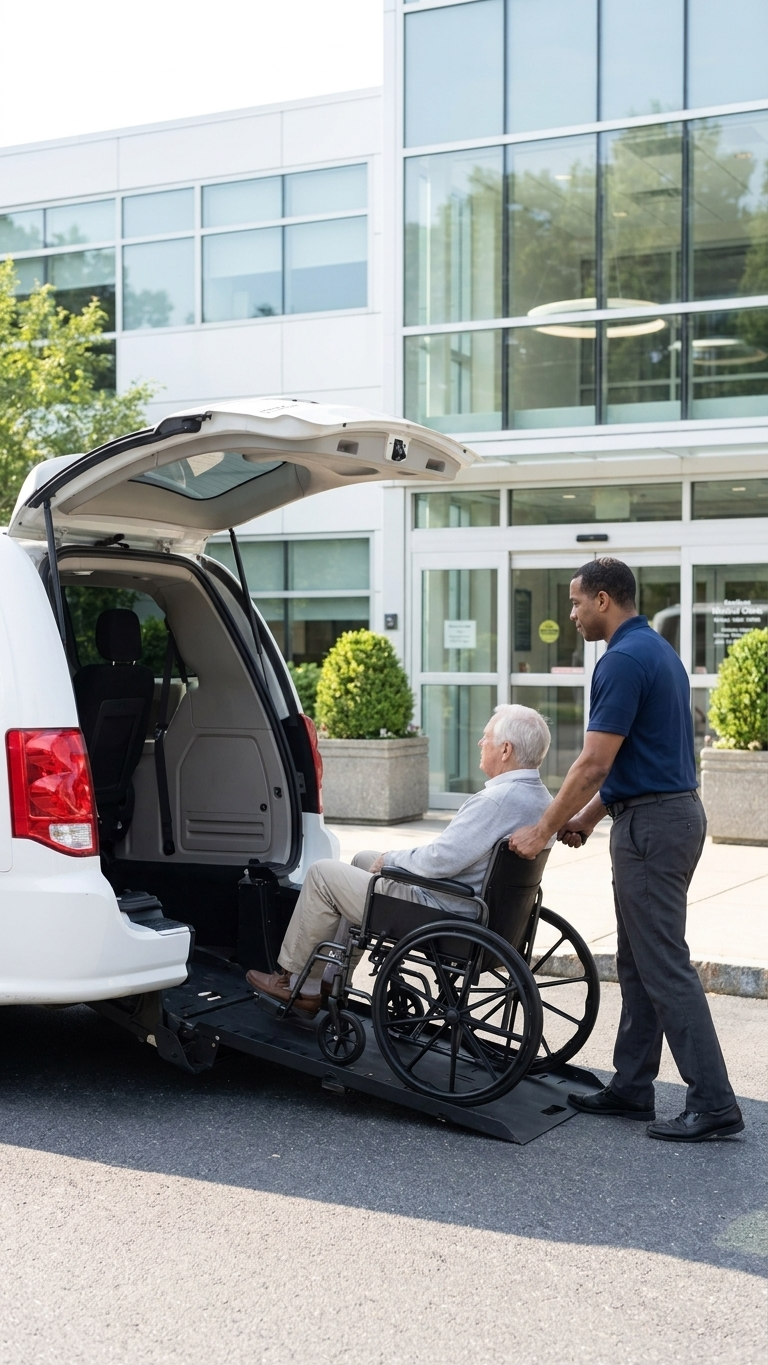
If the discharge team recommends travel in a wheelchair, request wheelchair transportation and explain the relevant details. For example, ask whether you will use your own chair or need to arrange one. Do not assume a chair used to bring you through the hospital will be available to take home.
Tell the provider about your chair type, its dimensions, and any features that affect fit or positioning. Ask what measurements they need instead of guessing. Include any restriction the clinical team gives you about transfers or leg position.
The provider should assess whether the vehicle and equipment fit the request. FedNor's website lists wheelchair accessible transport, including manual and powered wheelchairs, but your specific equipment and assistance needs still need review. FedNor: wheelchair and mobility options.
If there are stairs at the destination, raise them during booking. Wheelchair transportation does not, by its name alone, settle how someone will get through a staircase. Ask whether separate assistance is available and clinically appropriate. Describe the actual entrance rather than simply writing “a few steps.”
When to ask about stretcher transportation
Tell the discharge team if seated travel is a concern. Ask them to specify the position and level of support required, then ask the transportation provider whether it can meet those instructions.
FedNor advertises non emergency stretcher transportation for people who cannot remain seated during travel. That does not mean every person having surgery needs a stretcher, or that a stretcher service replaces an ambulance when clinical care is needed. FedNor: stretcher transportation.
For a stretcher request, discuss the whole route through the buildings. Ask about the pickup room, elevator access, entry doors, steps, and the final transfer at the destination. Who is responsible for moving you from one surface to another? What equipment and personnel will be used? Can the team maintain the position your clinician ordered?
If the transport company cannot confirm those details, involve the discharge planner. It is better to resolve a mismatch before a vehicle arrives than to discover that the planned equipment cannot reach the room.
What if nobody can pick you up?
Tell the office as soon as you know. You do not need an elaborate explanation or an apology.
“I do not have a family member or friend available to accompany me. I need help understanding which paid or community options your facility accepts.”
Ask whether there is a patient navigator, social worker, or discharge planning contact who can discuss the problem. Ask specifically about approved escorts, transportation assistance, and any separate requirement for care at home. Availability and eligibility must be checked; do not build your plan around a program until it accepts your request.
If you find a paid escort, confirm the person can do what the office requires. Being available to drive is different from staying during the appointment, hearing instructions, signing required documents, or remaining at home.
Be equally clear with a friend. Instead of asking vaguely for “a ride,” explain the time commitment and the tasks. Give them permission to say which parts they can manage. That makes it easier to arrange additional help without discovering a misunderstanding on surgery day.
Start with the facility, then book the service
Here is a practical order for the calls.
First, obtain the written discharge and escort instructions. Ask whether they apply to the anesthesia you are expected to receive and what happens if the plan changes.
Second, tell the office about mobility limitations, your home entrance, and whether you will be alone. Ask which details the transportation provider needs from the clinical team.
Third, contact the transportation company with the approved requirements. Request a quote for that specific level of service, not simply a distance between addresses.
Fourth, take any unanswered question back to the facility. If the driver will be the only person arriving, do not leave that fact implied. Ask whether the facility accepts the proposed arrangement.
Finally, confirm the reservation and the person who will receive you at home. Keep a copy where your helper can find it.
These are planning suggestions, not additional medical rules. Their purpose is to keep you from paying for a service before finding out whether it solves the problem the office actually raised.
Treat the return time as a conversation
Ask your surgery center what it can tell you about the likely discharge window. The published preparation guidance from PURE notes that schedules may change on the day of surgery and that the designated driver needs to be available for changes. PURE: surgery scheduling guidance.
Explain the uncertainty to the transportation provider. Ask whether the booking uses a fixed pickup time, paid waiting, or a pickup requested when the facility calls. Have the provider explain what each arrangement means for availability and charges.
FedNor's request page includes a Will Call choice for an unknown return time and describes waiting as an option with an additional fee. Confirm the response arrangements for your specific trip; selecting Will Call should not be interpreted as a guarantee of an immediate vehicle. FedNor: return trip options.
Choose one person to relay schedule updates. Ask the recovery unit whether it should call that person or the provider directly. Record the agreed process. Do not leave several relatives making separate changes to the same reservation.
Ask for a complete price before agreeing
You are allowed to care about cost. Medical instructions do not make a transportation bill easier to pay.
Request a written quote showing the route, ride direction, vehicle, assistance, and any waiting arrangement. Ask whether companion travel, additional stops, parking, tolls, stairs, or a schedule change would alter the amount. These are questions to clarify a quote, not a claim that every provider charges each fee.
Read the cancellation and rescheduling terms before payment. Ask what happens if the office changes the procedure date or the clinical team decides you need a different service. Do not assume those situations receive the same treatment under a provider's policy.
If you expect an insurer, facility, or another organization to pay, obtain confirmation from that payer before booking privately. Ask who must authorize and arrange the trip and whether the escort is included. A doctor's instruction to arrange transportation does not itself establish how your particular bill will be handled.
Save the response with the quote. If the answer is unclear, ask again before committing.
Make the last few feet part of the booking
Give the provider the entrance you will actually use. Include the apartment number, elevator situation, and any access instructions. If someone else holds the key, agree on when they will arrive.
Ask how far the transport team will assist you. “Door to door” can leave practical questions unanswered: the building entrance, your apartment door, or inside the home? Have the company describe the endpoint in plain language.
Ask the clinical team what help you will need once there. If a separate caregiver is expected, make sure that person knows the arrival arrangements and has the instructions they need. Do not assume a transportation attendant will stay for the evening or manage medication.
Before leaving for the procedure, put your phone charger, discharge paperwork folder, and necessary contact numbers where you can find them. Ask your helper to handle errands that do not need you present. Make returning home as straightforward as you can.
If the plan changes the night before
If your escort becomes unavailable, contact the procedure office through its published instructions and notify the transportation provider. Ask what alternatives the facility accepts. Do not assume an existing vehicle reservation covers the missing person.
If the surgery time changes, give the provider the new check in time and ask it to reconfirm both directions of travel. A change to the outward trip may also affect the return arrangement. Keep the updated confirmation rather than relying on an earlier message.
If you will recover at a different address, review access again. A ride originally planned to an elevator building is not the same practical request as arrival at a home with stairs. Tell the office and provider where you are actually going and who will be there.
Ask your helper to keep a short backup contact list. It should include the procedure office, transportation provider, and person receiving you. If a problem arises while you are unavailable, those contacts give the helper somewhere useful to start.
Avoid making a replacement booking without checking the terms of the first one. Confirm what has been canceled, what remains reserved, and whether any charge or credit applies. Otherwise, two people may arrive to provide the same ride while the escort requirement remains unresolved.
If no acceptable plan can be arranged, let the clinical team explain the next step. Do not change your treatment or medication instructions yourself to make a transport arrangement fit. The goal is to make a workable plan around the care you need.
Before ending the call, repeat the final arrangement in your own words. Ask the other person to correct anything you misunderstood. That small step is especially useful when the day has already become stressful and several details have changed.
A short checklist to use before surgery
Use this list to check your own arrangement, and add anything your office requires.
- I know the facility's escort requirement and have discussed my actual plan with staff.
- I have a confirmed transportation arrangement with the correct assistance and equipment.
- The pickup location and contact number are clear.
- Someone knows how to communicate a change in discharge time.
- The quote and cancellation terms have been reviewed.
- The home entrance and any stairs have been discussed.
- The person meeting me knows when and where to be available.
- Any required supervision after arrival is arranged separately.
- I know whom to call if the plan changes before the procedure.
If you cannot check one item, that gives you a focused question for the next phone call. It does not mean you have failed to prepare. You are finding the missing piece while there is still time to address it.
Requesting a ride home with FedNor
For a trip in Boston, Greater Boston, or MetroWest, you can begin with FedNor's online ride request form. The form asks for contact information, addresses, timing, ride direction, vehicle type, and special instructions. Its stated process is an estimate followed by confirmation, booking, and payment.
Describe the trip as a surgery discharge. If the pickup time is not known, say so. Include the assistance the facility has specified and the contact person coordinating departure. Ask about any detail that does not fit the form rather than guessing at the closest service option.
An online request is the start of that discussion. Obtain confirmation of availability and the agreed service, and make sure the facility accepts the arrangement. For urgent requests within the next 24 to 48 hours, the page directs patients to call (781) 552-4559 or submit the form for assistance. It does not promise availability. FedNor: request and booking instructions.
Questions patients should feel comfortable asking
Can I take a rideshare if a friend comes with me? Ask your facility. An accompanying friend may address the escort requirement, but the office still needs to approve the transportation arrangement and any care needed after arrival. Describe both people and the vehicle plan when you call.
Does a medical transportation driver automatically count as my escort? Do not assume that. Ask what the driver or attendant has agreed to do, then obtain the facility's acceptance. A transport reservation and an approved discharge arrangement should be confirmed separately.
What if I need help but do not use a wheelchair? Explain the help you need and ask about ambulatory service. Do not select wheelchair transportation just because you are having surgery. Let the care team's instructions and the provider's assessment guide the choice.
Should I arrange a stretcher because I expect to be tired? Ask your clinician to determine the appropriate travel position and assistance. Tiredness alone is not a reason to choose equipment without that discussion. Make a stretcher request when the required transport position and service have been identified.
What if I feel unwell before leaving? Tell the recovery staff before departure. Do not let a waiting vehicle rush the clinical decision about whether you are ready. For a medical emergency, call 911 rather than using a routine transportation request. FedNor: emergency notice.
You deserve to understand the plan for getting home. Ask the questions, write down the answers, and make sure the people helping you know their roles. Having that settled gives you permission to stop managing the ride and focus on the next part of the day: getting home and resting.
Need a ride you can trust?
FedNor Transportation provides safe, dignified non-emergency medical transportation across MetroWest Massachusetts.