
Key takeaway
Having eye surgery in Boston? Learn how to plan the ride home after cataract surgery, LASIK, or retinal procedures, including escort rules and the first checkup.
If you are having eye surgery, you may be looking forward to the moment you can see more clearly. It makes sense to think about the result. Give some attention to the trip home, too, when the procedure is over but you may not yet be seeing comfortably.
Start with the instructions from your eye surgeon. Ask whether you need a driver, an accompanying adult, or both, and whether you need another ride for the first checkup. Do not use the fact that you will be awake during treatment as a reason to assume you can drive afterward.
The National Eye Institute explains that vision may initially be blurry after cataract surgery. It also tells patients having LASIK and vitrectomy to arrange someone to take them home. These are different procedures with different recovery instructions, so the transportation plan should be specific to yours. NEI: cataract surgery, NEI: refractive surgery, NEI: vitrectomy.
You do not have to know every detail today. Start with the type of procedure and work outward: how you will leave, how you will travel, how you will enter your home, and how you will return for care.
The name of your procedure matters
When you call a transportation provider, “eye appointment” may not communicate the help you need. A routine examination, an operation, and a postoperative check are not the same request.
Give the name of the procedure if you have it. Then share the instructions that affect transportation, rather than trying to describe your entire medical history. For example, tell the scheduler if the office requires an accompanying adult or if the surgeon has specified a position for the journey.
Ask your eye team to clarify anything you do not understand. “Will I be able to travel seated?” is useful when positioning is uncertain. “Do I need someone to meet me inside?” is useful when the departure process is unclear.
Avoid accepting a generic answer from either side. If the office gives you a requirement, take it to the provider. If the provider identifies a limitation, take it back to the office. That conversation should happen before the day when your eyes may be uncomfortable and you would rather not make another call.
Cataract surgery: prepare for the first afternoon
The National Eye Institute notes that patients are usually awake during cataract surgery, may receive medicine to relax, and may initially experience blurry vision or sensitivity to light. Your doctor may prescribe drops and an eye shield or glasses and restrict some activities. NEI: what happens after cataract surgery.
For transportation planning, ask the office what those instructions mean for you. Should you bring sunglasses? Will a shield be in place? Does the office require someone to accompany you out? When will you be told it is appropriate to resume driving?
Arrange help with belongings if needed. Tell the person collecting you which entrance to use and whether staff will call when you are ready. Put the transport number somewhere accessible before your appointment.
If you are planning procedures on both eyes at separate visits, make a transport arrangement for each date. Do not copy the first reservation without checking the second appointment's location and timing. Ask whether the first follow up is at the same office as the surgery.
Keep the plan modest. A direct trip home gives you fewer things to organize than combining the pickup with errands and shopping.
LASIK: include the first follow up in your ride plan
For LASIK, the FDA specifically advises arranging transportation for surgery and the first follow up visit. Relaxing medication can impair driving, and vision may be blurry. The FDA advises a first postoperative visit within 24 to 48 hours, while your own office sets the exact appointment. FDA: before and after LASIK.
Before you pay for a round trip, decide what you actually mean by that phrase. It normally describes travel to an appointment and back from that appointment. It does not automatically reserve transportation for another visit the next day.
Write the surgery and follow up as separate entries. Include the pickup address, check in time, and return arrangements for each. If the clinic has several offices, confirm which one handles each visit.
If someone is helping only on the surgery date, discuss the second visit before assuming they can return. A short checkup still needs a transportation plan if you have not been cleared to drive.
The point is to avoid solving half the problem. Ask the clinic for the expected sequence, then make reservations around that sequence rather than around a hoped for recovery timetable.
Retinal surgery: clarify positioning before choosing a vehicle
After vitrectomy, some patients have a gas bubble placed in the eye and must hold their head in a prescribed position. The National Eye Institute also warns against flying or traveling to high altitudes while the bubble remains. Ask your surgeon what applies to your journey and how long the restrictions last. NEI: vitrectomy recovery.
Do not translate a positioning instruction into a vehicle choice on your own. A stretcher, reclining seat, or wheelchair is not automatically the answer. Ask the clinical team to specify the position during transport and ask the provider to confirm that its equipment can accommodate it safely.
Request written instructions if the positioning is difficult to explain. Give the transportation team an appropriate clinical contact for questions. The driver should not have to interpret an unfamiliar surgical instruction while you are waiting to leave.
For a longer journey, discuss the route and any elevation concerns with the surgeon. If you are staying somewhere temporarily, use that destination in the discharge plan. Do not assume approval to return to a local hotel also means approval for a different journey later that day.
Corneal procedures and other eye treatments
The National Eye Institute describes corneal transplant surgery as an outpatient procedure requiring a ride home and a checkup the next day. Its glaucoma laser guidance also says someone should drive you home because irritation and blurry vision can occur immediately afterward. NEI: corneal transplants, NEI: laser treatment for glaucoma.
Those examples are a reason to ask about the return journey even when the appointment is described as a treatment rather than surgery. They do not establish one escort rule for every eye clinic.
Tell the office how you normally travel and what help you already use. If a friend normally drops you at the entrance, ask whether that arrangement is sufficient for this visit. If you normally travel independently by transit, ask whether you should make a different plan after the procedure.
You are not asking permission to remain independent. You are asking for the information needed to make an appropriate plan for a particular day.
Can you take Uber or Lyft after eye surgery?
Ask the eye center before booking. Separate the driver from the accompanying person in that conversation.
“My friend can come with me, but neither of us will have a car. Does your discharge policy allow us to travel together in a taxi or rideshare?”
If no one is available, ask a different question:
“Will you accept a professional escort or medical transportation arrangement, and what exactly must that service provide?”
Do not assume that an app booking meets an escort requirement. Equally, do not assume every eye patient must hire a medical van. The right answer depends on the procedure, medications, mobility needs, and the facility's instructions. The FDA's LASIK guidance and NEI's procedure pages establish a need to arrange transportation in those contexts; they do not endorse a particular commercial provider.
If the facility says a professional service is acceptable, have it review the actual arrangement. A provider offering a ride, a provider supplying a separate escort, and a provider arranging support at home may be offering different things. Get a clear description of what you are purchasing.
Support with vision should be discussed directly
Tell the transportation provider what would make the pickup easier. You can ask for a phone call instead of relying only on a text, help identifying the correct vehicle, or a clear verbal explanation before movement.
If you use a cane or another mobility aid, describe how you prefer to be assisted. Ask the person helping you to speak to you directly, explain where they are standing, and let you say what you need. If you do not want physical assistance, say that too.
For a family member arranging the ride, involve the passenger in this conversation whenever possible. Do not assume that a vision diagnosis tells you how much help someone wants with walking, conversation, or personal belongings.
Before the day arrives, agree on where the driver and passenger will meet. “Outside” is not a complete pickup instruction when a building has several entrances. Ask for a named desk, exit, or other location that the facility approves.
These are practical communication requests. They should support the person's preferences without turning the journey into a series of unnecessary instructions.
Wheelchair transportation after an eye procedure
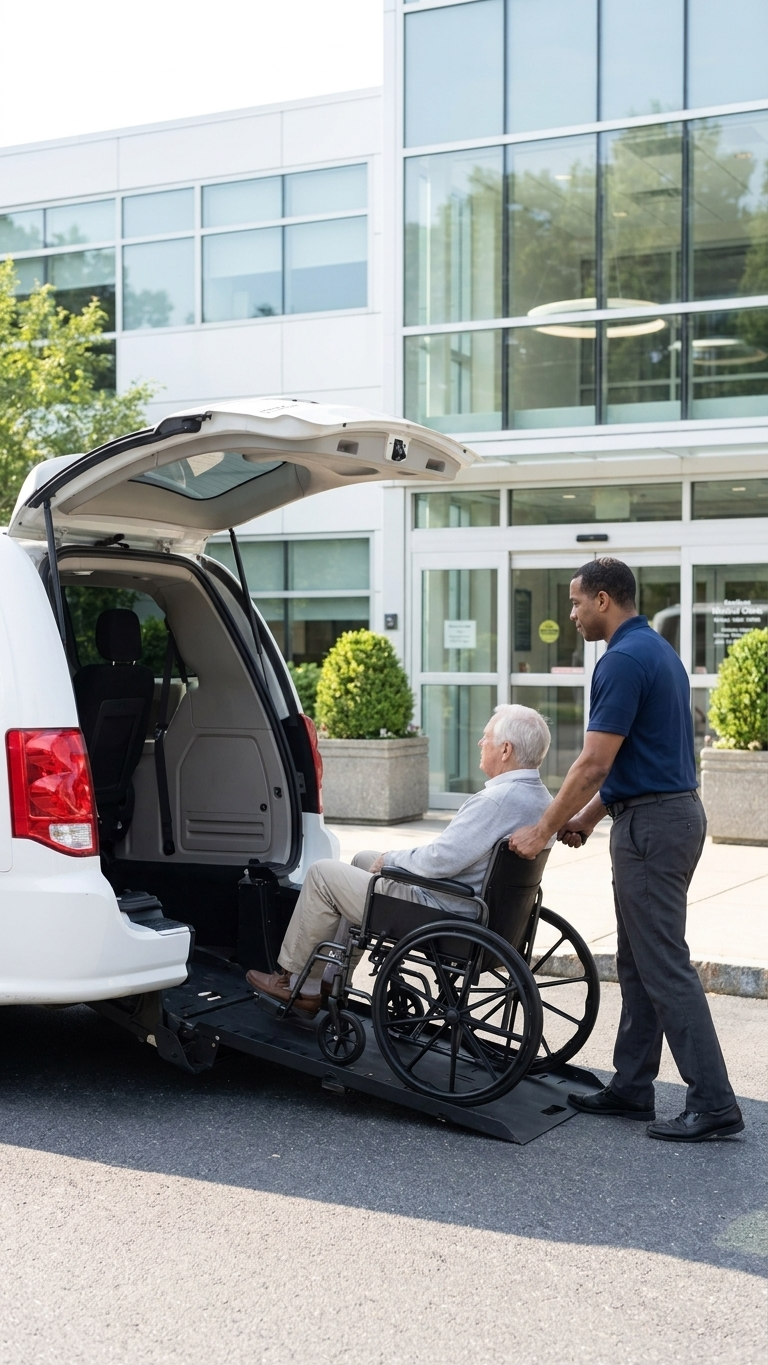
If you already use a wheelchair, start with the details of your normal travel arrangement and explain anything the surgery changes. Tell the provider the chair type and ask which measurements it needs. Include any instruction about transfers, head position, or assistance.
If you do not normally use a wheelchair, ask the clinical team whether one is needed for this discharge. Do not assume that eye surgery alone makes wheelchair transportation necessary. Your vision and your mobility are separate things to discuss.
FedNor lists wheelchair transportation among its services, alongside ambulatory rides. The team must still review the specific passenger and equipment requirements before confirming a trip. FedNor: available transportation options.
Ask who supplies any temporary chair and whether it will be needed after arrival. If the building has steps, provide the details before booking. Ask whether there is an accessible entrance that avoids them and whether the facility expects you to use it.
Do not leave equipment ownership, transfers, or the last part of the route to assumption. Write the answers down with the reservation.
Stretcher transportation requires an individual decision
If you cannot travel seated or have another condition affecting your travel position, ask the eye surgeon and discharge team to identify the correct transport. Then request a service assessment.
FedNor advertises non emergency stretcher transport, but a stretcher should not be presented as routine after eye surgery or as automatically suitable for retinal positioning. Clinical requirements and vehicle capabilities have to match. FedNor: stretcher service information.
Ask how the provider will maintain the prescribed position, manage transfers, and reach your destination room. Confirm whether the team needs written instructions from the surgeon. If clinical monitoring or treatment is required during travel, have the discharge team determine whether another level of service is necessary.
Do not make the decision by comparing vehicle photographs or choosing whichever option looks most comfortable. Comfort matters, but the surgeon's instructions must be addressed first. A provider should be willing to explain its limitations as clearly as its services.
Make the pickup easy to identify
Before surgery, collect the facility name, building address, department, and pickup entrance. Include a direct number for the person coordinating departure if the office provides one.
Tell the transportation provider whether someone will travel with you and whether that person is also the contact for updates. Ask whether staff should call the provider directly or call your companion first.
If your phone will be put away during treatment, tell everyone which number to use instead. Do not make your own availability the only way to activate the return ride.
Ask what happens if you are ready later than expected. A pickup window, a waiting arrangement, and a request made after discharge readiness are different scheduling choices. Have the provider explain which one you have reserved and how any additional cost works.
For a family member collecting someone, avoid guessing based on the expected length of the procedure. Follow the clinic's instructions for when to arrive or return. Keep the phone available so the office can reach you if its plan changes.
Bring the information in a format you can use
Ask for discharge instructions in an accessible format if standard print will be difficult to use. You might request larger print, a digital copy, or a verbal review with the person supporting you. Ask the office which options it can provide.
Before the appointment, save the surgeon's contact number and the transport number. Label them clearly. If you use accessibility features on your phone, set them up beforehand rather than expecting to adjust everything immediately after treatment.
Ask your companion to keep the written instructions with you. If the care team has prescribed eye drops, clarify who will collect them and who can help read the labels if needed. Medication questions belong with the clinical team or pharmacist, not the transportation driver.
If you want an audio recording of instructions, ask the clinician's permission first. The goal is a record you can use without relying on your memory or someone else's brief summary.
You should leave knowing how to reach help, even if you do not feel like reading a page that afternoon.
Look at your home entrance before the appointment
Walk through the arrival plan while you can give it your full attention. Which door will you use? Who has the key? Is there an elevator? Will someone meet you at the building entrance or inside the apartment?
Tell the provider about stairs and ask exactly what assistance is included. If another person will handle the final part of the journey, make sure the transport team knows who that is and how to reach them.
Ask your helper to keep the route free of bags and other objects. Put the items you expect to need in an easy to locate place. Avoid changing the layout of the room without discussing it with the person recovering.
If you normally live alone, ask your eye team whether someone should stay and for how long. Arrange that person separately from the driver unless the booked service specifically includes it. Do not assume that being escorted into the home means ongoing supervision has been provided.
Describe your real situation. The office can answer more usefully when it knows whether help is available once you arrive.
For an adult child arranging a parent's ride
Start by asking your parent what they want you to handle. Perhaps they want you to make calls but would rather receive the quote directly. Perhaps they want a companion in the vehicle. Perhaps the main concern is the stairs, not the drive.
With their permission, obtain the office's transportation instructions and share the relevant parts with the provider. Keep the procedure date and follow up date clearly separated. Use one contact for scheduling changes so different family members do not give conflicting directions.
Confirm who will be present at home and who will help with the instructions. If you live out of town, do not assume a neighbor has agreed to the whole afternoon because they offered to meet the car.
Send a short written plan to everyone involved. Include only the information each person needs: the time, place, contact, and responsibility. You do not need to circulate the patient's medical history to organize a pickup.
A good plan respects your parent's voice while making the practical work easier to share.
Price the surgery trip and follow up separately
Ask for a quote for each journey you expect to need. Check whether the surgery ride includes the trip to the center, the trip home, or both. Confirm waiting arrangements rather than assuming the driver remains throughout the procedure.
For the first checkup, ask whether the office expects the same assistance. Give the transportation provider the confirmed appointment time and location. If a companion will ride, include that in the request.
Ask how cancellation or rescheduling works if the eye office changes a date. If you are scheduling treatment for the second eye, request separate confirmation for that visit as well. Do not rely on the first booking as a standing reservation.
If cost is a concern, tell the office before you cancel care. Ask whether a patient support contact can help you investigate options. Do not assume a program is free, that you qualify, or that it fulfills an escort requirement until those details are confirmed.
Comparing prices is reasonable. Compare the same assistance and timing, so a lower quote does not simply omit the part you need most.
Request an eye surgery ride in Boston or MetroWest
FedNor provides non emergency medical transportation in Greater Boston and MetroWest. To begin a request, use the online ride form and identify the appointment as eye surgery or an eye procedure discharge.
Include the pickup and destination addresses, procedure date, timing information, companion details, and the assistance the office requires. If positioning needs clinical clarification, ask the office to provide it before the service is confirmed.
For wheelchair transportation, identify the equipment and any access concerns. For stretcher transportation, request a discussion of the clinical travel instructions and the physical route into the destination. Avoid selecting a vehicle simply because you are unsure which option applies.
FedNor's page describes a fare estimate and a confirmation process before booking and payment are completed. Submitting details does not replace the eye center's approval of your discharge plan. Keep that approval and the provider's reservation confirmation together. FedNor: booking process.
You can ask for transportation help without committing before the details are clear. The request should lead to a conversation about what you need, what is available, and what it will cost.
Questions to take to your eye care team
Use the questions that fit your procedure rather than treating this as another form to complete.
- What might affect my ability to travel immediately afterward?
- Do I need an escort, and what must that person do?
- Is my proposed transport arrangement acceptable?
- Are there positioning instructions during the drive?
- Should someone stay with me at home?
- When and where is the first follow up?
- Should I arrange a driver for that visit too?
- Who will tell me when driving is appropriate again?
- How should I contact the office if a symptom concerns me?
- Can I receive the instructions in a format I can comfortably use?
If you get different answers from different people, ask the office to clarify before booking. You do not need to decide whose instructions to follow by yourself.
What to do if something feels wrong after the procedure
Tell the clinical staff about a concern before departure. Once you are home, use the contact instructions provided by your eye team. For LASIK specifically, the FDA advises contacting the doctor immediately for severe pain or worsening vision or symptoms rather than waiting for the scheduled visit. FDA: LASIK recovery concerns.
A transportation provider can help arrange a suitable non emergency journey, but it cannot decide whether an eye symptom can safely wait. Ask the treating team where and how urgently you should be seen.
Do not turn a scheduled ride into a reason to delay asking for medical advice. If the situation is an emergency, use emergency services.
Keep the second visit from becoming an afterthought
Before you leave the first appointment, check the date, time, and location of the next one against your transportation confirmation. Ask whether any examination or medication at that visit could affect the journey home. Tell the provider if the assistance has changed.
If you are waiting for the surgeon to decide whether you can resume driving, keep that decision separate from the booking deadline. Ask the transport company how changes are handled and ask the office when you can expect guidance. You should not have to guess about your vision to avoid a transportation misunderstanding.
Give yourself a quieter trip home
If you want a calm ride with little conversation, say so. If you want each step explained, say that. If you want your companion beside you, ask about seating before the day arrives.
You do not have to perform being comfortable or independent for anyone after eye surgery. You can ask for help with a doorway and still make your own decisions. You can let someone carry the paperwork while you concentrate on getting settled.
Put the practical questions in the hands of the right people now: the eye team for clinical instructions, the provider for transportation, and your chosen helper for support at home. Then let the journey be simple. A clear meeting place, an appropriate ride, and someone who understands what you need when you arrive.
Need a ride you can trust?
FedNor Transportation provides safe, dignified non-emergency medical transportation across MetroWest Massachusetts.