
Key takeaway
No ramp? No problem. How families across MetroWest safely get an elderly parent from an upstairs bedroom to the doctor — without lifting, an ambulance, or canceling the appointment.
If you are reading this with a knot in your stomach because an elderly parent is upstairs in a bedroom and a doctor is expecting them in the morning, take a breath. You are not failing them. You have run into a problem that almost no one warns families about, and there is a real, safe, and surprisingly simple solution for it.
The answers come first, below, because you do not have the time or the patience for a sales pitch right now. Read the questions families ask us most, get exactly what you need, and then keep reading if you want to understand why this happens to so many older adults and their families across MetroWest Massachusetts, and what your real options are. One thing to settle right away, since it is the worry we hear most. If you do not have a wheelchair ramp, do not panic. You do not need one. FedNor has that part handled.
Quick Answers to the Questions Families Ask Us Most
My elderly parent cannot get down the stairs and the appointment is tomorrow. What do I do?
You do not lift them yourself, and you do not cancel the appointment. You call FedNor at 781.552.4559 and book a trip. This is exactly what non emergency medical transportation exists to handle. A trained team safely assists an older adult who is wheelchair bound, stretcher bound, or living with serious mobility limitations, including bringing them from an upstairs bedroom, down the staircase, into a properly equipped vehicle, to the appointment, and home again. The part that feels impossible at two in the morning when you are staring at the stairs is the part we do every single day.
We do not have a wheelchair ramp. Can FedNor still help?
Yes, absolutely, and please let this take a weight off your shoulders. You do not need a ramp, a lift, or any special equipment installed in your home. Our team brings what is needed and is trained to move a person safely without a ramp at all. Families often delay calling because they assume they have to modify the house first, or they feel embarrassed that they never got around to building a ramp. None of that matters. If your loved one is upstairs and needs to get to a doctor, we come to where they are, just as the house is, and we handle it. No ramp, no problem.
Do I have to call an ambulance just to get my parent downstairs?
No. Ambulances are built for emergencies like heart attacks, strokes, and serious injuries. A routine doctor visit, a urology appointment, a dialysis run, a wound care follow up, or a catheter change is not an emergency, even when getting there feels overwhelming. Non emergency medical transportation was created specifically for these planned, non urgent trips, so that ambulances stay available for true emergencies and so that your elderly loved one travels calmly and comfortably rather than in the middle of a crisis.
Should I call the fire department to carry my parent down the stairs?
Many families think of this, and firefighters are good people who sometimes step in. The problem is that fire departments exist to respond to emergencies, and pulling a crew away for a routine ride can leave them unavailable when someone nearby truly needs them. There is a service designed for your exact situation, and using it keeps emergency responders ready for the calls only they can answer. It also means your parent gets a team whose entire job is careful, unhurried medical transport, not a crew squeezing you in between calls.
My parent is bedridden and cannot sit up at all. How will they get to the doctor?
This is one of the most common calls we receive, so please know it is solvable. A patient who cannot sit upright travels safely lying down on a secured stretcher, moved by a team trained to bring them from the bed, down the stairs, and into the vehicle without strain or risk to anyone. Catheter changes, urology visits, dialysis, infusion treatments, and wound care are all routine reasons for this kind of transport. Missing those appointments is what creates real medical trouble, which is why dependable transportation matters far more than most families realize until they are in the middle of it.
We already built a ramp outside, but the stairs inside the house are still the problem. Can you help with that?
Yes, and you have put your finger on something most people miss. A ramp solves the outdoor step at the front door. It does nothing for the staircase inside the home that leads up to the bedroom. Plenty of families invest in ramps, grab bars, and outdoor lifts, then discover that the second floor is still the wall they cannot get past. Moving a person safely from an upstairs room down to the front door is the part most families simply cannot do on their own, and it is exactly the part a trained professional team is equipped to handle, ramp or no ramp.
Do you serve my town?
If you are in Hudson, Concord, Sudbury, Wayland, Weston, Belmont, Hopkinton, Framingham, or the surrounding MetroWest and Greater Boston communities, yes. A large reason this guide exists is that families in these towns often have no idea the service is available right in their own area. You do not have to drive your loved one yourself, and you do not have to send them an hour away to find help. Help is local, and it is closer than you think.
What does it cost and how do I book?
Call FedNor at 781.552.4559 with the date, time, pickup address, destination, and whether your loved one needs a wheelchair, a powered chair, or a stretcher. We confirm everything in advance and give you a clear price up front, with no surprises on the day of the ride. Booking a few days ahead is always wise, since schedules fill, but when an appointment is tomorrow and the panic is real, call anyway and we will do everything we can to make it work.
I feel completely overwhelmed and do not know where to start.
Start with one phone call. You do not need to have everything figured out before you reach out. You explain what is happening, where your loved one is in the home, and what the appointment is for, and the team builds the plan around that. The hardest part is usually believing the problem can be solved at all. It can, and you are already most of the way there simply by looking for the answer.
The Problem No One Prepares Families For
There are few things harder than watching an aging parent slowly lose the ability to move through their own home. For most of your life, the stairs in that house were nothing. Your mother climbed them carrying laundry. Your father came down them every morning for coffee. Nobody ever thought about them. They were just stairs.
Then something shifts. A fall. A stroke. A long recovery from surgery. A diagnosis that changes everything. A simple, gradual loss of strength that creeps in over a year or two until one day you realize your parent has not been downstairs in a week. And now there is an appointment on the calendar, a doctor expecting them, a treatment that cannot be delayed, and a flight of stairs standing between your loved one and the care they need.
This is the moment almost no one prepares you for. You learn about wheelchair ramps. You learn about handicap parking and accessible entrances and grab bars in the shower. What no one tells you is that there is an entire category of transportation built specifically for people who cannot safely travel in an ordinary car, and that it is available right in your community. So families get caught completely off guard. You have spent weeks coordinating the appointment, talking to doctors, managing medications, watching for every small change in how your parent is doing, and then appointment day arrives and a question lands that you were never warned about. How are we actually going to get them there?
Mobility in older adults can change faster than families can adapt. Someone walks on their own one season, leans on a walker the next, needs a wheelchair after that, and may eventually become stretcher bound. Each stage brings new equipment, new limits, and new fears, and most families are learning all of it in real time while already carrying a heavy emotional load. Transportation should not become one more crisis stacked on top of all of that, yet it so often does, simply because no one ever told them another option existed. The option exists, it is local, and it is built for exactly this.
"We Do Not Have a Ramp" Is Not the Obstacle You Think It Is
Let us spend real time here, because this single misunderstanding stops more families from getting help than almost anything else. Over and over, we hear some version of the same hesitation. We never built a ramp. The house is not set up for this. We are not ready. We would have to renovate first. People convince themselves that they cannot ask for help until their home has been modified, and so they wait, and the waiting turns into missed appointments and mounting stress.
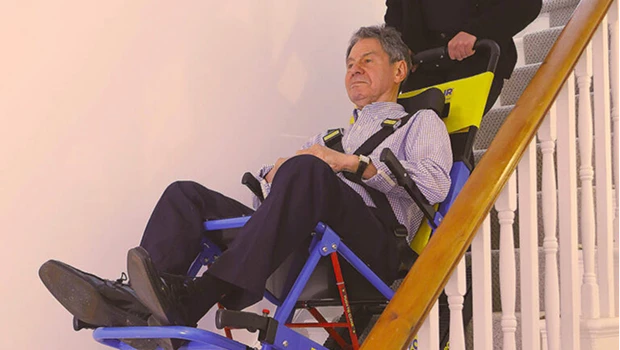
Here is the truth. You do not need a ramp to get your elderly loved one to the doctor. You do not need a stair lift, a chair lift, a renovated entryway, or any construction at all. FedNor comes to your home as it is. Our team is trained and equipped to move a person safely down a staircase, through a doorway, and out to the vehicle without any of the equipment you think you are supposed to have already installed. The whole point of a professional medical transportation team is that we bring the capability with us. You do not have to prepare the house. You do not have to be embarrassed about the stairs, the clutter, the narrow hallway, or the fact that you simply never got around to building a ramp. We have seen every kind of home, and we handle every kind of home.
A ramp, for the families who do have one, solves exactly one thing. It bridges the step or two at the outside door so a wheelchair can roll out to the driveway. That is genuinely useful, and we are glad when a family has one. But a ramp does nothing about the staircase inside the house, the one that climbs from the first floor to the bedroom where your parent actually is. That interior staircase is almost always the real barrier, and it is the one families cannot solve with a single home modification. This is why so many people who have already spent money on ramps and lifts still find themselves stuck. They solved the outdoor problem and ran straight into the indoor one.
So whether you have a beautiful new ramp or no ramp at all, the answer is the same. Call us. We bring the team and the equipment. We handle the stairs. You do not need to build anything, change anything, or apologize for anything. The barrier you have been treating as a wall is, for us, just another Tuesday.
How FedNor Actually Gets Your Parent Down the Stairs Safely
Families understandably want to know what this looks like in practice. The honest short version is that it looks calm, careful, and far less dramatic than the disaster you have been imagining in your head at night.
When you cannot safely move a loved one yourself, the danger is not only to them. It is to you. A spouse may not have the strength. An adult child may be terrified of slipping. A caregiver may not have the equipment or the training, and a single missed step on a staircase can injure both the person being carried and the person carrying them. That fear is completely rational, and it is exactly why this should never be a job you attempt alone. The right answer is not to try harder. The right answer is to hand the staircase to people who do this professionally.
Our team arrives with the proper equipment and the training to use it. We assess the home, the staircase, the doorways, and the path to the vehicle, then move your loved one steadily and securely, supporting them the entire way, with the goal of making the whole thing feel as unremarkable and dignified as possible. For someone in a wheelchair, that includes safely transferring and securing them. For someone who cannot sit up, it means a stretcher and a team trained to manage the angles and turns of a real home, not a hospital corridor. Every driver is background checked, CPR certified, and trained in passenger sensitivity and mobility assistance, and every vehicle is inspected and sanitized. Your parent is not cargo. They are a person who deserves to be moved with care and treated with respect, and that is the standard we hold.
Why an Ambulance or the Fire Department Is Not the Answer
When a loved one cannot get downstairs, an ambulance is often the first idea that comes to mind, because people associate ambulances with anything medical. But ambulances are designed for emergencies. Heart attacks. Strokes. Serious injuries. When a non emergency ride is handled by an ambulance, it strains a system already stretched responding to real crises, and it is the wrong experience for your parent, who is already anxious and does not need a jarring, clinical trip for a routine visit. Non emergency medical transportation bridges that exact gap, providing safe, equipped, professional transport for planned trips while leaving emergency responders free for true emergencies.
The fire department comes up a lot too, and it comes from a good place. Firefighters are kind and capable, and some will help in a pinch. But this cannot be your plan. Every minute a crew spends carrying someone downstairs for a routine appointment is a minute they are not available for a true emergency elsewhere in town, and they cannot promise to be there on a schedule that fits your parent's doctor. FedNor is built precisely for this, available on a schedule you can count on, with a team whose entire job is getting your loved one safely to care. You do not have to rely on the goodwill of an emergency crew, and you do not have to feel like you are imposing. You simply book the ride.
Why Urology and Catheter Care Cannot Wait
A great deal of the stress around elder transportation shows up around urology, and it deserves a clear explanation, because catheter care is far more common among older adults than people outside of healthcare realize.
Many seniors, stroke survivors, surgical patients, and people with neurological conditions rely on an indwelling urinary catheter, often called a Foley catheter. These catheters do not last indefinitely. Depending on the type and the patient, they typically need to be changed on a regular schedule, often every few weeks to a few months, by a clinician who knows how to do it safely. Some patients use a suprapubic catheter, which also requires routine changes and monitoring.
When a catheter change gets delayed, the consequences are not minor. The catheter can become blocked or encrusted, urine can back up, and the risk of a urinary tract infection rises sharply. In a frail older adult, a urinary infection can escalate quickly and turn into something serious that lands them in the hospital. Urology appointments also address recurring infections, urinary retention, bladder management, and prostate concerns. None of these are things to put off because the drive felt impossible.
And this is precisely where transportation becomes the hidden barrier. Many of these patients cannot sit upright in a sedan, cannot transfer from a bed to a car seat, and live above a flight of stairs. The appointment itself might take twenty minutes. Getting there is the real challenge. A stretcher equipped vehicle and a team trained to move someone safely turns a missed appointment into a kept one, and that single difference can protect your loved one from a far worse week, or a hospital stay, down the road. No family should ever skip a catheter change because the stairs felt like too much. That is a solvable problem, and it is one we solve constantly.
When Sitting Up Is Not Possible: Stretcher Transport for Elders
Families often picture transportation as helping someone into the passenger seat. For an older adult who cannot bear weight, cannot sit up, or is recovering from surgery, that picture is not realistic, and trying it at home can injure both the patient and the family member doing the lifting.
Stretcher transport solves this completely. The patient stays lying down throughout the trip on a secured stretcher, moved by people who do this every day and know how to manage stairs, doorways, and tight hallways inside a real home. For a bedridden senior, this is frequently the only safe way to leave the house for care at all. It is also far gentler than most families expect. There is no wrestling, no improvising, no holding your breath at the top of the stairs hoping nothing goes wrong. There is a trained team, a proper stretcher, and a steady, practiced process.
Wheelchair transportation works on the same principle for those who can sit but cannot manage a regular vehicle. We provide secured transport for manual chairs and for patients who need full four point securement for the ride, so the chair is locked safely in place the entire way. Whether your loved one travels sitting or lying down, the goal is identical. Safe, comfortable, dignified, and on time.
Powered Wheelchairs and the Heavy Chair Problem
There is one capability worth calling out on its own, because it traps more families than almost anything else. A powered or motorized wheelchair can weigh several hundred pounds, far more than a manual chair, and a great many transportation services simply cannot take one. Families who rely on a heavy power chair hear no again and again, and that repeated no slowly confines an older adult to a few rooms of their own home. Appointments get skipped. The world shrinks to the size of a bedroom.
FedNor transports powered and motorized wheelchairs up to 600 pounds with four point securement. This is genuinely rare, and it changes lives. It means a senior who depends on a heavy power chair can keep their dialysis schedule, keep their cancer treatment, keep their specialist visits, and keep their independence. When senior services and even fire departments across MetroWest encounter a family stuck because of a power chair, this is often the capability they point them toward, because so few providers can actually handle it. If you have been told your loved one's chair is too heavy or too complicated, you have not run out of options. You have just not called us yet.
Dialysis, Cancer, and the Appointments That Repeat
Some medical care is not a single visit. It repeats, sometimes for months, sometimes for years. Cancer patients may have weekly infusions, lab work, imaging studies, and specialist follow ups stacked across the calendar. Dialysis patients usually travel several times a week, every week, with no room to skip a session. Wound care, physical therapy, and post hospital follow up appointments pile on even more trips.
For a family, that rhythm is exhausting on its own. When every one of those appointments also raises the question of how to physically get a weakened older adult out of the house and down the stairs, the exhaustion compounds into something close to despair. This is where reliable, scheduled transportation changes everything. Instead of solving the same impossible problem from scratch before every single appointment, the plan is already in place. The ride is booked. The team knows your loved one. The family gets to spend its limited energy on the person rather than the logistics. For families walking through a long illness, that steadiness is not a small convenience. It is often the difference between coping and falling apart.
The Quiet Weight Caregivers Carry
There is a part of this that almost never gets said out loud. Caregivers, and especially adult children caring for aging parents, often feel responsible for fixing everything. When transportation becomes a wall they cannot climb, they feel guilty, frustrated, and alone. They lie awake the night before appointments. They call relatives. They search online late at night. They wonder whether they are somehow supposed to manage this by sheer effort and love.
You are not. Caregiving was never meant to be a one person job, and asking for the right help is not a weakness or a failure. Using a service built specifically for safe medical transport is one of the most responsible and protective decisions a caregiver can make, both for their loved one and for their own back, their own sleep, and their own peace. There is nothing noble about injuring yourself trying to carry a parent down a staircase, and something genuinely loving about making sure they get to their doctor safely, even if the hands that get them there are not your own. Handing off the hard, physical, risky part does not make you less devoted. It makes you wise.
Why So Many MetroWest Families Have Never Heard of This
We hear the same sentence constantly. I wish I had known about this sooner.
It is striking how many families in Hudson, Concord, Sudbury, Wayland, Weston, Belmont, Hopkinton, and Framingham are quietly struggling with this exact situation and have no idea a local provider can help. They assume their only choices are a family car they cannot safely use, an ambulance they do not need, or canceling the appointment and hoping it can wait. They do not know there is a fourth option sitting right in their own region, often just a town or two away.
That gap in awareness is the entire reason for this guide. There are people across MetroWest right now caring for a bedridden parent, a spouse recovering from surgery, or a family member on dialysis who genuinely believe they are stuck. They are not stuck. They simply have not yet learned that wheelchair and stretcher transportation is available close to home, that it works with or without a ramp, and that it was built for precisely this. If this is the first time you are hearing that this kind of help is real and local, then this guide has already done its job.
What Happens When You Call FedNor
The process is far simpler than the worry that comes before it. You call 781.552.4559 and explain the situation. Where your loved one is in the home. Whether they need wheelchair, powered wheelchair, or stretcher transport. The date, time, and location of the appointment. You do not need to know all the right words. You do not need to have measured the staircase or built a ramp. You just tell us what is happening, and we take it from there.
From that point, the trip is scheduled and the right vehicle and team are arranged. On the day itself, the team comes to the home, safely moves your loved one from wherever they are, transports them comfortably, and brings them back. Round trips, return rides after dialysis or treatment, hospital discharge transport home, and transfers between facilities all work the same way. We confirm the details in advance and give you a clear price up front, so there are no surprises when the day arrives.
What you trade for that one phone call is the days of dread, the unsafe lifting, the canceled appointments, and the sleepless nights. FedNor is BBB Accredited with an A rating and holds a 5 star Google rating, but the badges are not really the point. The point is that the thing you have been losing sleep over is, for us, a routine and solvable part of an ordinary day.
You Were Never Meant to Do This Alone
If you are standing at the bottom of a staircase right now, looking up, wondering how on earth the person you love is going to make it to their appointment tomorrow, hold on to this. You are not the first family to face it. You are not the only one facing it tonight. And you do not have to solve it by yourself.
There are transportation services built for exactly these circumstances. For older adults with serious mobility limitations. For stretcher transport. For wheelchair transport. For powered chairs that other companies turn away. For families who have reached the point where an ordinary car is no longer enough, and who do not have a ramp, and who feel like they have run out of options. The stress that has been sitting on your shoulders does not have to stay there.
Let the transportation be someone else's responsibility. Let the stairs, the planning, the lifting, and the logistics belong to a team that does this safely every day, so that you can give your attention to the only thing that ever truly mattered here, which is being present for the person you love. You do not need a ramp. You do not need to renovate the house. You do not need to risk your own back or your parent's safety on a staircase. You just need to make the call. That is the whole reason FedNor Transportation exists, and it is why no family in MetroWest should ever have to choose between unsafe transportation and missing the care their loved one needs. No one left behind.
FedNor Transportation, LLC. Serving Hudson, Concord, Sudbury, Wayland, Weston, Belmont, Hopkinton, Framingham, and all of MetroWest Massachusetts. Call 781.552.4559 or visit fednortransportation.com.
Need a ride you can trust?
FedNor Transportation provides safe, dignified non-emergency medical transportation across MetroWest Massachusetts.