
Key takeaway
A complete and honest guide to non emergency medical transportation in Massachusetts — what it is, what it costs, how stretcher and powered wheelchair transport works, and how to choose a provider you can trust.
Most people never think about medical transportation until the day they desperately need it. One moment life is normal, and the next you are standing in a hallway, phone in hand, realizing that the person you love cannot get to a doctor and you have no idea what to do about it. If that is where you are right now, you are in the right place. This guide was written for you, slowly and carefully, to be the resource we wish every family had before the panic set in.
We are FedNor Transportation, a non emergency medical transportation company based in Framingham and serving families across MetroWest and Greater Boston Massachusetts. But this is not a sales page, and we are not going to spend ten thousand words telling you how wonderful we are. We are going to tell you the truth about how all of this works, what your options are, how to choose a good provider, what it costs, and how to handle the specific and frightening situations that bring most families here in the first place. A bedridden parent who needs to get down a staircase. A catheter change that cannot be missed. An infusion appointment for cancer treatment. A loved one who can no longer sit up in a car. If we earn your trust by being genuinely useful, that is enough. Let us begin where the fear usually begins.
Start Here: Real Questions From Families Who Just Found Out They Need This
These are not polished marketing questions. These are the things people actually say when they call us, often with a shake in their voice. If you see your own situation here, read that answer first and breathe.
I have never heard of this before. What even is non emergency medical transportation?
It is a real and established service, and the fact that you have never heard of it is not your fault. Non emergency medical transportation, which most people in the field shorten to NEMT, is professional transportation for people who need to get to medical care but do not need an ambulance. It exists for exactly the situation you are probably in right now, where a regular car will not work because your loved one uses a wheelchair, cannot sit up, cannot walk safely, or cannot be moved without trained help. It is not an emergency service and it is not a taxi. It is a careful, equipped, scheduled ride built around a person who needs more than an ordinary vehicle can offer. Thousands of families use it every day, and most of them, like you, had no idea it existed until the moment they needed it.
My mom cannot walk and her appointment is tomorrow morning. Is this something I can actually call right now?
Yes. You can call a non emergency medical transportation provider today, explain that your mother cannot walk and has an appointment tomorrow, and ask them to schedule a ride. You do not need a referral to make the call. You do not need to be a medical professional. You just need to describe the situation, the date and time, the pickup address, and where she needs to go. A good provider will tell you right away whether they can do it and what it will cost. The hardest part for most families is simply not knowing this was an option. Now you know.
Is this an ambulance? I really do not think she needs an ambulance, but she cannot get into a car.
You have described the exact gap that non emergency medical transportation fills. An ambulance is for emergencies, for heart attacks and strokes and serious injuries, and it would be the wrong and very expensive choice for a routine appointment. A regular car or rideshare will not work because she cannot safely get in or out. NEMT sits in the middle. It gives you the equipment and trained help of medical transport without the lights, the sirens, the emergency room, or the emergency bill. For a person who cannot use a car but is not in crisis, it is almost always the right answer.
She is in a bed upstairs and cannot sit up at all. Can anyone really get her down the stairs?
Yes, and please let that sink in, because this is the fear that keeps families frozen. A patient who cannot sit upright is transported lying down on a stretcher, and a trained team brings her from the bed, through the bedroom, down the staircase, and out to the vehicle. This is routine work for people who do it every day. You are imagining a disaster because you are picturing yourself trying to do it alone, which you should never attempt. With a professional stretcher transport team, it is steady, practiced, and far calmer than you expect. The stairs are not the end of the road. They are just part of the job.
We never built a wheelchair ramp. Does that mean we cannot use this?
No. You do not need a ramp, a lift, or any special equipment installed in your home. A professional transportation team brings what is needed and is trained to move a person safely without a ramp at all. Many families delay calling because they assume the house has to be modified first, or they feel embarrassed that they never got around to building a ramp. None of that matters. The team comes to your home exactly as it is. A ramp helps with the single step at an outside door, but it does nothing about the staircase inside the house, which is usually the real obstacle anyway. No ramp is not a barrier. It is simply a thing you do not need.
How much is this going to cost? I am honestly scared it will be thousands of dollars.
It is far less than an ambulance, and a good provider will give you a clear price before you book, so you are never blindsided. The cost depends on the type of transport, the distance, and whether your loved one needs a wheelchair, a powered wheelchair, or a stretcher, since a stretcher trip involves more equipment and more staff. The honest answer is that prices vary, which is exactly why you should ask for a quote up front and expect a straight answer. A trustworthy provider explains the price plainly, includes the driver assistance and wait time in what they quote, and does not surprise you with hidden fees on the day of the ride. Never feel awkward about asking what something costs. You deserve to know before you commit.
Does the driver come inside the house, or do I have to somehow get her to the curb myself?
This is one of the most important questions to ask, and the answer separates good providers from bad ones. The level of help is usually described in three ways. Curb to curb means they pick up and drop off at the curb and you handle the rest. Door to door means they come to the door of the home and assist from there. Door through door means they come inside, help the person from where they are, and stay with them to the door of the destination. For a bedridden or seriously limited person, you want door through door or full assistance that includes getting them from the bedroom to the vehicle. Always ask a provider exactly how much help is included so there are no painful surprises when the vehicle arrives.
My dad has a catheter appointment and I am terrified of missing it. Can you take him?
Yes, and you are right to take it seriously. Catheter care is one of the most common reasons families call for medical transportation, and missing a scheduled catheter change can lead to real harm. If your father cannot sit up, he can travel by stretcher. If he uses a wheelchair, including a heavy powered wheelchair, that is handled too. The appointment itself is usually short. Getting him there safely is the real challenge, and that is precisely what this service solves. You will not be the first family to make this exact call, and the people on the other end will know exactly what you mean.
Is this only for elderly people?
No. While a large share of riders are older adults, non emergency medical transportation serves anyone who cannot safely use ordinary transportation to reach medical care. That includes people recovering from surgery, people living with disabilities, people undergoing cancer treatment, people on dialysis, younger adults with neurological conditions, and individuals in day habilitation programs. Age is not the qualifier. Mobility and medical need are. If getting to care in a regular car is unsafe or impossible, this service is for you, whatever your age.
How quickly can someone come?
It depends on the provider, the time of day, and how busy they are, which is why booking ahead is always wise when you can. That said, if you are in a tight spot with an appointment tomorrow, call anyway and ask. Many providers will do their best to accommodate short notice, especially for recurring needs like dialysis or a time sensitive catheter change. The sooner you call, the more options you will have, so do not wait until the morning of the appointment if you can avoid it.
I do not even know what kind of vehicle she needs. How am I supposed to figure that out?
You do not have to figure it out alone. When you call, describe what is true. Can she walk at all, or not? Can she sit up, or not? Does she use a wheelchair, and if so, is it a manual chair or a heavy powered one? Is she in a bed and unable to move on her own? From those plain answers, the provider will tell you whether she needs ambulatory transport, wheelchair transport, or a stretcher. You are not expected to know the right terms. Describing the reality of her situation is enough.
I called another company and they told me they could not take my mother's wheelchair. Is that normal?
Sadly, yes, it happens often, and it is one of the most frustrating walls families hit. Many providers cannot handle heavier powered or motorized wheelchairs, and some cannot manage certain chair sizes or configurations at all. That first no does not mean your mother is out of options. It means that company was not equipped for her chair. Look for a provider that specifically states it handles powered and motorized wheelchairs, ideally up to six hundred pounds with four point securement. FedNor handles exactly these chairs, and families come to us all the time after being turned away elsewhere. Do not let one no convince you the whole answer is no.
My father gets confused and frightened around strangers. Will the driver be patient with him?
A good provider trains drivers in passenger sensitivity precisely because so many riders are frightened, confused, in pain, or living with dementia. The right team moves slowly, speaks gently, explains what is happening, and gives your father the time he needs without rushing him. When you call, tell the provider about his confusion and his fears so they can prepare and assign the right person. How a company responds to that information will tell you a great deal about whether they are the right fit.
Can I ride along with her? I do not want her to go alone.
In most cases, yes. A family member or companion is usually welcome to ride along, and for many patients, having a familiar face makes the entire trip calmer and safer. Always confirm this when you book, but the answer is generally yes, and a thoughtful provider will encourage it rather than discourage it.
What if the appointment runs long? Will the driver just leave?
This is exactly why you ask about wait time before you book. Some trips are arranged as round trips with the driver waiting, and some are booked as a pickup once the appointment is done. For a treatment like dialysis or infusion that runs a known length, the schedule is built around it. For an appointment with an uncertain end time, a good provider works out a plan with you in advance so your loved one is never stranded. Clear communication on this point is the mark of a provider worth trusting.
Do you serve my town?
FedNor serves a wide stretch of MetroWest and Greater Boston, and we list sixty Massachusetts cities and towns later in this guide, from Framingham and Natick to Upton, Hopkinton, Hudson, Lexington, Concord, Quincy, and Boston itself. If your town is on that list, or anywhere nearby, the answer is almost certainly yes. And if you are reading this from a community we have not named, call and ask, because our service area keeps growing and we would rather hear from you than have you assume you are out of reach.
What Non Emergency Medical Transportation Actually Is
Now that the most urgent worries have answers, let us slow down and explain the whole picture, because understanding how this works will help you make good decisions and ask the right questions.
Non emergency medical transportation is a category of professional transport designed for people who need to reach medical care but do not require the emergency response of an ambulance. The phrase itself tells you what it is by telling you what it is not. It is medical, in that the vehicles and staff are equipped to handle people with serious mobility and health needs. It is transportation, in that the goal is simply getting a person safely from one place to another. And it is non emergency, in that it is planned and scheduled rather than dispatched to a crisis.
In practice, NEMT covers an enormous range of everyday medical travel. It carries people to doctor appointments, specialist visits, dialysis centers, chemotherapy and radiation sessions, infusion appointments, wound care, physical therapy, behavioral health appointments, outpatient surgery, and routine checkups. It brings people home from the hospital after a discharge. It moves patients between facilities, from a hospital to a rehabilitation center, or from a nursing home to a specialist and back. It supports adults in day habilitation programs who need a reliable ride to and from their daily activities. Wherever a person needs to go for their health, and an ordinary car will not do, this is the service that fills the gap.
The reason so few people have heard of it until they need it is that it lives quietly in the background of the healthcare system. Hospitals, social workers, discharge planners, and case managers know it well, because they coordinate these rides constantly. Families, on the other hand, usually meet it for the first time in a moment of stress, when a parent declines or a diagnosis lands and suddenly the simple act of getting to an appointment becomes a mountain. If that is how you found it, you are in good and very large company.
Who Non Emergency Medical Transportation Is For
It helps to picture the real people this service was built for, because you may recognize someone you love in this list.
There is the elderly parent who has slowly lost the strength to walk and can no longer manage the steps to the driveway. There is the stroke survivor who cannot move one side of the body and cannot transfer into a car seat. There is the cancer patient who is too weak after chemotherapy to drive home and needs a steady, comfortable ride. There is the dialysis patient who travels three times a week, every week, and cannot miss a single session. There is the person recovering from hip or knee surgery who cannot bend or bear weight yet. There is the individual living with a progressive neurological condition like ALS, Parkinson's, or multiple sclerosis, whose mobility changes month to month. There is the person who uses a heavy powered wheelchair that no ordinary vehicle can carry. And there is the bedridden patient who cannot sit up at all and can only travel lying down on a stretcher.
What unites all of these people is not age or diagnosis. It is that ordinary transportation has stopped working for them, and the alternative cannot be missing their care. Non emergency medical transportation exists so that a body that has become hard to move is never the reason a person goes without the medicine, the treatment, or the attention they need.
The Difference Between NEMT, an Ambulance, and a Rideshare
Families are often confused about where this service fits, so let us make it simple by laying the three options side by side.
An ambulance is emergency medical transport. It is staffed by emergency medical technicians or paramedics, equipped for life support, and meant for situations where someone's life or stability is at immediate risk. It is the right call for a suspected heart attack, a stroke, a serious fall, or sudden severe symptoms. It is the wrong call, and a very costly one, for a routine appointment, and using it that way also pulls a crew away from someone who may truly need them.
A rideshare or taxi is ordinary transportation. It assumes the passenger can walk to the car, get in and out on their own, and ride sitting upright in a standard seat. It offers no equipment, no trained assistance, no wheelchair securement, and no help to the door. For a person with serious mobility limitations, it is simply not an option, no matter how convenient the app may be.
Non emergency medical transportation is the bridge between those two. It provides trained, equipped, patient transport for people who cannot use a car but are not in crisis. The staff know how to assist someone with limited mobility, how to secure a wheelchair, how to manage a stretcher, and how to move a person safely through a real home with stairs and narrow doorways. It is scheduled, it is calm, and it is built entirely around the dignity and safety of the rider. When you understand these three categories clearly, the right choice for most appointments becomes obvious.
Understanding the Types of Medical Transport
Within non emergency medical transportation, there are several distinct types of service, matched to what a person can and cannot do. Knowing the difference will help you describe your loved one's needs accurately.
Ambulatory transportation is for people who can walk, at least a little, with some assistance. They can sit upright in a standard seat but should not be driving themselves or navigating alone, perhaps because of frailty, confusion, recovery, or fatigue. An ambulatory ride provides a steady arm, door to door help, and a safe seat for someone who simply needs support rather than equipment.
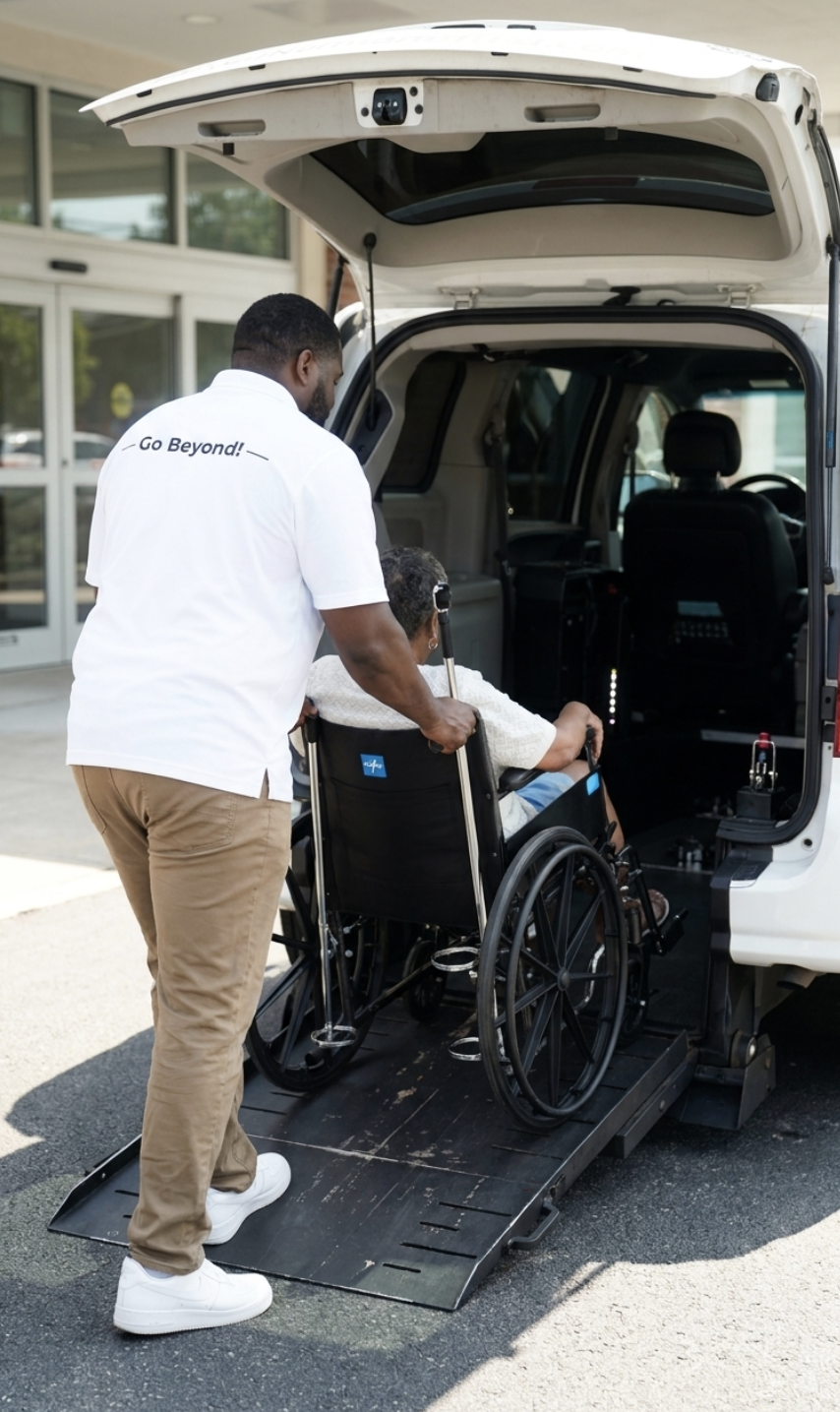
Wheelchair transportation is for people who use a wheelchair and cannot transfer easily into a regular car seat. The vehicle is equipped with a ramp or a lift and with proper securement so the chair is locked safely in place for the entire ride. Good wheelchair accessible transportation handles manual chairs without trouble, and the best providers also handle powered and motorized wheelchairs.
Powered wheelchair transport deserves its own mention, because it traps more families than almost anything else. A powered or motorized wheelchair can weigh several hundred pounds, far more than a manual chair, and many transportation services cannot accommodate one. FedNor transports powered and motorized wheelchairs up to six hundred pounds with four point securement, locking the chair down at four anchor points so it cannot shift in transit. This capability is genuinely uncommon, and it is one of the most frequent reasons families seek us out, because they have already been told no by someone else.
Stretcher transportation, also called gurney transport, is for people who cannot sit upright at all. This includes the bedridden, those recovering from certain surgeries, and patients whose condition requires them to remain lying down. The patient travels flat on a secured stretcher, moved carefully from the bed to the vehicle by a trained team. For many of these riders, a stretcher is the only safe way to leave the house, and it is the difference between keeping an appointment and missing it.
Knowing which of these your loved one needs is helpful, but if you are unsure, simply describe what they can and cannot do when you call, and the provider will guide you to the right service.
Specialized and Long Distance Transportation Needs
Beyond the core types of transport, there are a few specialized situations worth understanding, because families facing them often assume, wrongly, that no one can help.
Bariatric transportation is transport for larger individuals who need vehicles, equipment, and stretchers rated for higher weight capacities and additional support. Standard equipment is not always sufficient for a bariatric patient, and being turned away can be humiliating and frightening for a family already under strain. A provider equipped for bariatric transportation, with the right vehicles and a trained team, makes sure that size is never the reason a person goes without care. If you have been told your loved one is too large to transport safely, ask specifically about bariatric capability, because it exists.
Long distance medical transportation is for trips that go well beyond a local appointment, such as transport to a specialized hospital in another part of the state, a move to a rehabilitation facility far from home, or a relocation to be near family. These trips are usually priced by route rather than by a flat local rate, so the right step is to call and ask for a custom quote that fits the specific distance and the level of transport required. A patient who needs to travel a long way for care, whether sitting, in a wheelchair, or on a stretcher, can still travel safely and comfortably with the right provider.
There are also patients with complex needs who require extra coordination, such as those traveling with oxygen, those needing transport very early or very late in the day, or those whose condition requires careful timing around medication or treatment. A strong provider treats these as solvable details rather than reasons to say no. When in doubt, describe the full situation and let the provider tell you what is possible. You will often be surprised at how much can be arranged.
The Stairs Problem: Getting a Bedridden Loved One Down Safely
For so many families, the entire crisis comes down to a staircase. The appointment is scheduled. The vehicle can be arranged. And then there is the bedroom on the second floor and a flight of stairs that feels utterly impossible.
Let us be clear and gentle about this. You should never try to carry a seriously limited or bedridden person down a staircase by yourself or with another untrained family member. The risk to them is a fall, and the risk to you is a serious back or joint injury that can leave two people hurt instead of one. The fear you feel about those stairs is wisdom. Listen to it.
The right answer is not to find more strength or more courage. It is to hand the staircase to people who are trained and equipped to manage it. A professional stretcher transport team knows how to move a person who cannot sit up from a bed, through a bedroom, around a tight landing, and down a staircase, steadily and safely. They assess the path before they move anyone. They support the person the entire way. They do this in real homes, not just hospital corridors, every single day, and what feels like an emergency to you is, to them, a routine and well practiced task.
And to repeat the reassurance that so many families need to hear twice, you do not need a ramp for any of this. You do not need to renovate, install a lift, or modify the entryway. The team brings what is needed and works with the home as it is. The staircase you have been staring at, dreading, losing sleep over, is not the wall you think it is. It is simply part of the trip, and it is a part that trained professionals handle so that you never have to take that risk yourself.
Catheter Care Transportation: Why Foley Catheter Changes Cannot Wait
A large amount of the stress that brings families to non emergency medical transportation centers on urology and catheter care, and it deserves a thorough and honest explanation, because this need is far more common than people outside of healthcare realize.
Many older adults, stroke survivors, surgical patients, and people with neurological conditions rely on an indwelling urinary catheter, often called a Foley catheter. These catheters do not last forever. Depending on the type and the patient, they generally need to be changed on a regular schedule, often somewhere between every few weeks and every few months, by a clinician trained to do it safely. Some patients instead have a suprapubic catheter, placed through the lower abdomen, which also requires routine changes and careful monitoring. These are not optional appointments. They are scheduled medical maintenance that keeps a person healthy.
When a catheter change is delayed or missed, the consequences can be serious. The catheter can become blocked or encrusted, urine can back up, and the risk of a urinary tract infection rises sharply. In a frail patient, a urinary tract infection can escalate quickly, sometimes into a dangerous systemic infection that leads to a hospital admission that was entirely preventable. Beyond catheter changes, urology appointments also address recurring infections, urinary retention, bladder management, and prostate concerns. None of these are things to put off because getting there felt too hard.
And getting there is exactly where so many families get stuck. A patient who needs a catheter change frequently cannot sit upright in a car, cannot transfer from a bed to a car seat, and lives above a flight of stairs. The appointment itself might take fifteen or twenty minutes. The transportation is the real obstacle. This is precisely what catheter care transportation solves. A stretcher equipped vehicle and a trained team turn an impossible morning into a manageable one, and that single solved problem can protect your loved one from a far worse outcome down the road. If your family is facing recurring catheter change appointments and dreading each one because of the logistics, please know that this is one of the most ordinary and solvable situations a provider sees.
Cancer Treatment and Infusion Appointment Transportation
Cancer changes a family's entire calendar. Treatment is rarely a single visit. It is a long series of appointments stretched across weeks and months, and transportation to all of them quietly becomes one of the heaviest burdens a family carries.
Infusion appointments are a central part of this. Chemotherapy is frequently delivered as an infusion, and many patients also receive immunotherapy, targeted therapy, iron infusions, hydration, antibiotics, or other treatments through an infusion center on a recurring schedule. These appointments can last hours, and the patient often leaves them weaker, more fatigued, or more nauseated than when they arrived. Driving themselves before treatment is hard enough. Driving home afterward is frequently unsafe or impossible. This is where reliable infusion appointment transportation becomes essential, providing a steady ride to the center and a comfortable, careful ride home when the patient has nothing left to give.
Radiation therapy adds its own rhythm. Many radiation plans involve daily sessions, five days a week, for several weeks. That is a relentless schedule of trips, and arranging each one individually is exhausting on top of the treatment itself. Lab work, imaging studies, and specialist follow ups stack on even more. For a family already absorbing the emotional weight of a cancer diagnosis, the transportation alone can feel like a second full time job.
This is the case for setting up recurring, scheduled cancer treatment transportation rather than scrambling before each appointment. When the rides are arranged in advance on a standing schedule, the family stops solving the same problem over and over and starts simply showing up for the person they love. The patient rides with people who come to know them. The plan is in place. And the energy that would have gone into logistics goes instead into care, comfort, and presence. For anyone walking a loved one through cancer treatment, that steadiness is not a small thing. It is often what holds the whole season together.
Dialysis Transportation and the Rhythm of Recurring Trips
Dialysis is one of the most demanding recurring medical needs there is, and dialysis transportation is one of the most important services a non emergency medical transportation provider offers.
Patients with kidney failure typically receive dialysis three times a week, every week, with no room to skip a session. Missing dialysis is not like missing a routine checkup. It is genuinely dangerous, because the treatment is doing the work the kidneys can no longer do. Sessions also leave many patients drained and unsteady, which makes the trip home its own challenge. The combination of an unforgiving schedule and a patient who may be too weak to manage ordinary transportation is exactly why dependable dialysis transportation matters so much.
A good provider sets up dialysis rides as a standing, recurring arrangement, so the same trips happen on the same days without the family having to rebook each time. The vehicle is matched to the patient's needs, whether that is ambulatory, wheelchair, or stretcher transport. Drivers come to know the patient and the routine. And the whole rhythm of the week becomes something the family can rely on rather than something they have to fight. For dialysis patients and their loved ones, that reliability is the difference between a manageable life and a constant emergency.
Other Recurring and Routine Appointments We Cover
While catheter care, cancer treatment, and dialysis bring many families to medical transportation, the everyday needs are just as important, and a strong provider covers them all.
Wound care transportation matters more than people expect. Patients recovering from surgery, living with diabetes, or healing pressure injuries often need regular visits to a wound care clinic, and missing those appointments can let a manageable wound become a serious one. Reliable wound care transportation keeps healing on track.
Physical therapy and occupational therapy appointments tend to come in courses, several visits a week over weeks or months, especially after surgery, a stroke, or a fall. Like dialysis and radiation, the value of a standing, recurring ride here is enormous, because consistency is what makes the therapy work.
Behavioral health and psychiatric appointments are part of complete care, and transportation should support them without judgment. Getting to counseling, psychiatric follow ups, and substance abuse and addiction recovery treatment is just as legitimate a reason for safe, dependable transport as any physical appointment, and a compassionate provider treats these trips with the same care and discretion as any other.
Outpatient surgery and post operative follow up visits are another common need. A patient leaving an outpatient surgery center cannot drive themselves home, and the follow up appointments that come after often arrive while they are still limited and recovering. Safe transport through that recovery window protects the result of the surgery itself.
And then there is the simplest and most universal need of all, the routine doctor appointment. The primary care visit, the cardiology or pulmonology checkup, the orthopedic follow up, the eye or specialist appointment. For a person who can no longer drive or ride in an ordinary car, even an ordinary checkup becomes impossible without help. Medical appointment transportation exists so that no routine visit is ever skipped simply because getting there became too hard.
Hospital Discharge Transportation and Facility Transfers
Two of the most stressful and time sensitive moments in medical transportation are hospital discharges and transfers between facilities.
Hospital discharge transportation is the ride home, or to a rehabilitation center, after a hospital stay. It sounds simple, but discharge timing is rarely exact. Families are often told their loved one is being released, then left waiting, and the patient may need a wheelchair or stretcher to leave safely. A good provider coordinates with the discharge team and the family so the right vehicle is ready at the right entrance when the patient is actually cleared to go, turning a chaotic and uncertain moment into a smooth one. Getting a person home safely and comfortably after a hospital stay is its own kind of care, and it should never be an afterthought.
Facility transfers, also called inter facility transfers, move patients between locations. That might mean a transfer from a hospital to a skilled nursing facility, from a nursing home to a specialist appointment and back, from a rehabilitation center to home, or between two hospitals for specialized care. These trips require coordination, the right level of transport, and staff who understand how to move medically fragile people. Nursing home transportation and rehabilitation transport are everyday parts of this work, and a strong provider handles them with the same care as any other ride.
The Massachusetts Hospitals and Treatment Centers Families Travel To
Massachusetts is home to some of the finest medical care in the world, which is a gift, but it also means patients across our region travel to a wide range of hospitals and treatment centers, often far from home. Part of what makes a local provider valuable is genuine familiarity with these destinations, their entrances, their patient drop off points, and the routes that reach them. Here is a sense of where families across MetroWest and Greater Boston regularly need to go.
In Boston itself sits the heart of New England medicine. Massachusetts General Hospital, Brigham and Women's Hospital, and Beth Israel Deaconess Medical Center anchor the city, while Dana Farber Cancer Institute draws patients from across the state for cancer treatment and infusion appointments. The Longwood Medical Area concentrates many of these institutions together, along with specialty centers. Tufts Medical Center, Boston Medical Center, and Massachusetts Eye and Ear add to the city's reach. For a family in a western suburb, a trip to one of these centers can mean navigating the Mass Pike, Storrow Drive, and the dense hospital district, which is far easier with drivers who know the way.
In Cambridge, Mount Auburn Hospital serves as a trusted community and teaching hospital. North and west of the city, Lahey Hospital and Medical Center in Burlington is a major destination for specialty care, and Winchester Hospital and Newton Wellesley Hospital handle a great deal of routine and specialty needs for the suburbs. To the northwest, Lowell General Hospital and the Chelmsford and Lowell medical corridor serve the Merrimack Valley edge of our region.
Closer to MetroWest, Emerson Hospital in Concord and MetroWest Medical Center in Framingham and Natick provide care without the long drive into the city, and Milford Regional Medical Center serves the southwestern towns around Milford, Upton, Hopkinton, and Mendon. Across Norfolk County and the South Shore, patients travel to community hospitals and to the major Boston centers depending on their needs.
The point of naming all of this is not to impress you. It is to reassure you. Wherever your loved one's care happens to be, from a neighborhood clinic to a world renowned cancer center, the destination is rarely the hard part. Getting the person safely there is, and that is precisely the part a good non emergency medical transportation provider exists to handle.
Day Habilitation and Community Transportation
Not all medical transportation is about a single appointment. For many adults living with disabilities, getting to a day habilitation program is a regular and essential part of life.
Day habilitation transportation provides reliable, recurring rides to and from community based programs that offer skill building, therapy, social connection, and daily structure for adults who need support. For the individuals in these programs and for the families and group homes that support them, dependable transportation is what makes participation possible. A missed ride is not a minor inconvenience. It can mean a missed day of therapy, routine, and connection. This is why scheduled, consistent day habilitation transportation, with drivers trained in passenger sensitivity, is such a meaningful part of what non emergency medical transportation offers. It is transportation in service of a full life, not just a medical errand.
Senior Transportation and Aging in Place
A great deal of non emergency medical transportation is, at its heart, senior transportation, and it is deeply tied to one of the strongest wishes older adults have, which is to stay in their own homes as they age.
Aging in place is a beautiful goal, and a realistic one for many families, but it depends on solving practical problems, and transportation is near the top of the list. When an older adult can no longer drive safely, the world can shrink fast. Doctor appointments get harder. Recurring treatments become a strain. Social life narrows. Reliable senior transportation keeps that world open. It means a person can keep their specialists, keep their treatments, keep their routines, and keep their independence, even after they have given up the car keys.
Good senior transportation is about more than the vehicle. It is about patience, about giving an older person the time they need to move at their own pace, about a friendly and familiar face, and about treating someone with the dignity they have earned over a long life. For families helping a parent age in place, knowing that safe, kind transportation is available takes one of the largest worries off the table and makes the whole plan workable.
What to Expect: How a Trip Actually Works, Step by Step
If you have never arranged medical transportation before, the unknown can be intimidating. Here is what the process actually looks like from start to finish, so you can picture it clearly.
It begins with a phone call. You explain the situation in plain language. Who needs the ride, where they are in the home, whether they can walk, sit up, or only lie down, what kind of wheelchair they use if any, the date and time of the appointment, the pickup address, and the destination. You do not need medical terminology. You just describe reality.
From there, the provider confirms what type of transport is needed, quotes you a clear price, and schedules the trip. A good provider will confirm the details with you so there are no misunderstandings. If this is a recurring need, like dialysis or daily radiation, you can often set up a standing schedule so you do not have to rebook each time.
On the day of the trip, the team arrives at the scheduled time. They come to where your loved one is, whether that is a first floor living room or a second floor bedroom. They assist or move the person safely, using the right equipment for their needs, and they help them into the vehicle, securing a wheelchair or stretcher properly. During the ride, the focus is on comfort and safety. At the destination, they help the person inside and, depending on the level of service, to the door of the appointment.
For the return trip, the same care applies. After a treatment or appointment, the team brings the person home, back up the stairs if needed, and settled safely. Round trips, return rides after dialysis or infusion, and discharge rides home all follow this same reliable pattern. Once you have been through it once, the mystery is gone, and what felt overwhelming becomes simply a phone call and a plan.
Preparing for the Day of the Trip: A Practical Checklist
A little preparation makes the day of a medical transport calmer for everyone, and especially for your loved one. None of this is required, but it helps.
Have the basics ready and written down. The appointment time and address, the name of the doctor or clinic, and any instructions the office gave you. Keep your provider's phone number handy in case anything changes.
Prepare your loved one gently. Let them know who is coming and what will happen, especially if they are anxious or confused. Make sure they have used the bathroom recently, are dressed comfortably, and have shoes or slippers if they will be transferring. For a stretcher trip, comfortable clothing and a familiar blanket can help.
Gather what they may need at the appointment. A current list of medications, an insurance card if the clinic requires it, any paperwork the office requested, eyeglasses, hearing aids, and a phone or a way to reach you. For a longer treatment like infusion or dialysis, a bottle of water, a snack if allowed, and something to pass the time can make a real difference.
Clear the path. Make sure the route from the bedroom to the door is as open as it can be, with loose rugs, cords, and clutter moved aside if possible. The team is trained to work in any home, but a clear path makes the move smoother and safer.
Tell the team what they need to know. When they arrive, mention anything important. A painful side, a recent fall, a fear of being touched in a certain way, or a preference your loved one has. The more the team understands, the more gently and personally they can help.
And finally, give yourself a moment. You have done the hard part already by arranging the ride. Once the team is there, you are allowed to exhale.
How to Choose a Non Emergency Medical Transportation Provider
Not all providers are the same, and because you are trusting someone with a vulnerable person you love, it is worth knowing what separates a good one from a poor one. Here are the standards a strong non emergency medical transportation provider should meet. Use this as a checklist.
They should be properly licensed and insured. This is the baseline. Ask, and expect a clear answer.
Their drivers should be background checked, CPR certified, and trained in passenger sensitivity and mobility assistance. The person moving your loved one matters as much as the vehicle.
Their vehicles should be clean, inspected, sanitized, and ADA compliant, with proper ramps, lifts, and securement equipment. Cleanliness and maintenance are signs of how a company treats the people it carries.
They should offer the full range of transport you might need, including ambulatory, wheelchair accessible, powered wheelchair, and stretcher transportation. A provider who can only handle one type will leave you stranded when needs change.
They should be able to handle powered and motorized wheelchairs, not just manual ones. This is where many providers quietly fall short, so ask directly.
Their pricing should be transparent. You should get a clear quote up front, with driver assistance and wait time included, and no hidden fees sprung on you on the day of the ride. A provider who will not give you a straight price is telling you something.
They should clearly explain their level of assistance, whether curb to curb, door to door, or door through door, so you know exactly how much help your loved one will receive.
They should know the local roads, hospitals, and facilities. A provider familiar with the entrances at Massachusetts General, Brigham and Women's, Dana Farber, Beth Israel Deaconess, Mount Auburn, Lahey, Newton Wellesley, Tufts Medical Center, Boston Medical Center, Emerson, MetroWest Medical Center, Milford Regional, and Lowell General is not figuring out your loved one's trip for the first time.
They should communicate clearly and treat you with patience and kindness, especially when you are frightened. How a company speaks to you on the first call tells you a great deal about how they will treat your loved one.
And they should have a real reputation. Look for genuine reviews, accreditation such as a Better Business Bureau rating, and a track record in the community. FedNor, for example, is Better Business Bureau accredited with an A rating and holds a five star Google rating, but whatever provider you consider, look for real evidence that other families have trusted them and been glad they did.
If a provider meets these standards, you can hand them your worry with confidence. If they fall short on several, keep looking. The right provider is out there, and you are allowed to be choosy when it comes to someone you love.
Questions to Ask Before You Book
To make that checklist practical, here are the specific questions worth asking on your first call to any provider. Write them down if it helps.
Ask what type of transport they recommend for your loved one's specific situation. Ask whether they can handle a powered wheelchair if that applies. Ask exactly how much assistance is included, and whether they will come up to the bedroom and down the stairs. Ask whether you need a ramp, so you can hear them reassure you that you do not. Ask for a clear, all in price, and what could change it. Ask whether wait time and driver assistance are included. Ask whether they can set up a recurring schedule if you need one. Ask how far in advance you should book, and what they can do for short notice. Ask whether a family member or companion can ride along. And ask how they handle delays, like a discharge that runs late or an appointment that goes long. A good provider will welcome every one of these questions. A provider who seems annoyed by them is answering you in a different way.
For Social Workers, Case Managers, Discharge Planners, and Facilities
Not everyone reading this is a family member. Many of the people who arrange non emergency medical transportation are professionals, the social workers, case managers, discharge planners, group home staff, and facility coordinators who keep patients moving safely through the system. If that is you, you deserve a provider who makes your job easier, not harder.
The qualities that matter to a coordinator are slightly different from those that matter to a frightened family, though they overlap. You need reliability above all, because a missed ride becomes your problem and your patient's risk. You need a provider who communicates clearly, confirms trips promptly, and tells you honestly whether they can cover a request rather than overpromising. You need flexibility for the realities of discharge timing, recurring schedules, and last minute changes. You need a partner who can handle the full range of needs you encounter, from ambulatory to wheelchair to powered chair to stretcher, so you are not juggling several vendors. And you need a team that treats your patients with the dignity that reflects well on the care you have arranged for them.
A strong local provider becomes an extension of your team. FedNor works with healthcare facilities, group homes, and care coordinators across MetroWest and Greater Boston, handling recurring transportation, hospital discharges, inter facility transfers, and day habilitation runs, and we aim to be the call you can make with confidence when a patient needs to move and the timing is tight. If you coordinate care for others, a dependable transportation partner is one of the most valuable relationships you can build.
Understanding Costs and Payment
Money is one of the most stressful parts of this for families, so let us talk about it honestly.
The cost of non emergency medical transportation depends on several things. The type of transport matters most, because a stretcher trip requires more equipment and more trained staff than an ambulatory ride, and is priced accordingly. Distance matters, since a trip across town costs less than a long distance medical transport to a facility in another part of the state. Wait time, the level of assistance, and whether the trip is one way or round trip all factor in as well.
The most important thing you can do is ask for a clear quote before you book, and choose a provider who gives you one without hesitation. A trustworthy provider includes the essentials, like driver assistance and reasonable wait time, in the price they quote, and does not surprise you with add ons later. Transparent, up front pricing is not just convenient. It is a sign of an honest operation.
FedNor focuses on clear, direct pricing so that families know what to expect before the day of the ride, with no hidden fees. Whatever provider you choose, hold them to that same standard. You are already carrying enough. The cost of getting your loved one to care should be one thing you understand plainly, not one more source of anxiety.
The Emotional Side: A Word for the Caregivers
This guide has been full of practical information, but we would be doing you a disservice if we did not pause to speak directly to the person reading it, because that person is often a caregiver running on empty.
If you are the one coordinating appointments, managing medications, watching for every small change, and lying awake before each trip wondering how you will manage, please hear this. You were never meant to do this alone. Caregiving was not designed to rest on one set of shoulders, and the fact that transportation has become a wall you cannot climb is not a failure on your part. It is simply a hard problem that has a real solution.
There is no nobility in injuring your own back trying to carry a parent down a staircase, and there is no shame in handing the hardest physical parts of caregiving to trained professionals. In fact, choosing safe, capable help is one of the most loving and responsible decisions you can make, for your loved one and for yourself. You matter in this story too. Your health, your sleep, and your ability to keep going all matter, because the person you care for needs you whole. Letting a transportation team carry the part that was never safe for you to carry alone is not giving up. It is being wise enough to accept help.
Common Myths About Medical Transportation
A few persistent misunderstandings keep families from getting help they could have. Let us clear them up.
The first myth is that you have to call an ambulance. You do not, and for a non emergency appointment you should not. NEMT is the appropriate and far more affordable choice.
The second myth is that you need a ramp or a modified home. You do not. A professional team brings what is needed and works with your home exactly as it is.
The third myth is that a bedridden person simply cannot be moved. They can, safely, by stretcher, by a trained team, even down a flight of stairs.
The fourth myth is that this service is only for the very elderly. It is for anyone whose mobility or medical condition makes ordinary transportation unsafe, at any age.
The fifth myth is that it must be outrageously expensive. It is far less than an ambulance, and a good provider gives you a clear price before you commit.
The sixth myth is that you have to figure out all the medical details yourself before you call. You do not. Describing your loved one's real situation in plain words is all that is needed. The provider handles the rest.
If any of these myths has been holding your family back, let it go. The help is more available, more affordable, and more capable than you may have believed.
Where FedNor Serves: Sixty Massachusetts Cities and Towns
One of the most common reasons families never find this service is that they assume it is not available in their area. So here, plainly, are sixty Massachusetts cities and towns where FedNor Transportation provides non emergency medical transportation, including wheelchair transportation, powered wheelchair transport, stretcher transportation, ambulatory transport, dialysis transportation, cancer treatment and infusion appointment transportation, catheter care transportation, hospital discharge transportation, and senior transportation. If your community is here, help is local.
Across MetroWest Massachusetts, we serve Framingham, Natick, Ashland, Holliston, Hopkinton, Upton, Hudson, Marlborough, Southborough, Northborough, Westborough, Sudbury, Wayland, Weston, and Wellesley.
Through the towns of southern Middlesex and northern Norfolk counties, we serve Sherborn, Medfield, Millis, Medway, Franklin, Milford, Hopedale, Mendon, and Bellingham.
Across the historic communities of Middlesex County, we serve Lexington, Concord, Acton, Maynard, Carlisle, Lincoln, Bedford, Stow, and Littleton.
Through the cities and towns just north and west of Boston, we serve Burlington, Woburn, Waltham, Watertown, Belmont, Arlington, Cambridge, Somerville, Winchester, and Newton.
Across Norfolk County and toward the South Shore, we serve Needham, Dedham, Westwood, Norwood, Walpole, Canton, Sharon, Foxborough, Wrentham, Norfolk, and the neighboring communities.
Through the South Shore and the communities south of the city, we serve Stoughton, Randolph, Braintree, Quincy, Milton, and Brookline.
And into Suffolk County and the heart of Greater Boston, we serve Boston itself, along with the surrounding neighborhoods and nearby communities.
That is sixty Massachusetts communities, and the list continues to grow. From Upton and Hopkinton in the west to Quincy and Milton in the south to Boston in the center, families across the region have access to safe, professional, non emergency medical transportation closer to home than they ever realized. If you live in or near any of these towns, you are within reach. And if your town is not named, call and ask, because we would always rather hear from you than have you assume the answer is no.
Why Families Across MetroWest and Greater Boston Reach Out to FedNor
We promised this would not turn into a sales pitch, and we have kept that promise for nearly ten thousand words. So we will say only this, plainly and briefly.
FedNor Transportation was founded in Framingham to make sure that no family in Massachusetts has to choose between unsafe transportation and missing the care a loved one needs. We provide wheelchair transportation, powered wheelchair transport for chairs up to six hundred pounds with four point securement, stretcher and gurney transportation, ambulatory transport, dialysis transportation, cancer treatment and infusion appointment transportation, catheter care transportation, wound care transportation, hospital discharge transportation, inter facility and nursing home transfers, day habilitation transportation, and senior transportation across MetroWest and Greater Boston. Our drivers are background checked, CPR certified, and trained in mobility assistance. Our vehicles are inspected, sanitized, and equipped. We are Better Business Bureau accredited with an A rating and hold a five star Google rating. And we handle the stairs, with or without a ramp, so that the part you have been dreading becomes the part you no longer have to worry about.
But more than any of that, we try to treat every person we carry the way we would want our own family treated. With patience, with dignity, and with genuine care. That is the whole reason we exist.
How to Get Started
If you have read this far, you are likely carrying a real and pressing need, so let us make the next step simple.
Call FedNor Transportation at 781.552.4559. Tell us what is happening in plain words. Where your loved one is, what they can and cannot do, what the appointment is for, and when it is. We will tell you exactly what kind of transport is needed, give you a clear price, and build the plan around your family. You do not have to have it all figured out. You just have to make the call, and the hardest part, the not knowing, will be over.
You can also learn more at fednortransportation.com, where you will find our full range of services and service areas.
If you are nervous about that first call, know that there is no wrong way to make it. You do not have to use the right words, have your paperwork ready, or know which service your loved one needs. You can call simply because you are overwhelmed and do not know where to begin, and that is a perfectly good reason to reach out. The person who answers has spoken with many families in exactly your position, frightened and unsure, and the whole purpose of that first conversation is to take the weight of figuring it out off your shoulders. You describe the situation, and together you make a plan. By the time you hang up, the thing that kept you awake will have a date, a time, and a team behind it.
A Plain Glossary of Medical Transportation Terms
If the language around this service has felt confusing, here is a plain explanation of the terms you are most likely to hear, so you can speak with any provider confidently.
Non emergency medical transportation, or NEMT, is professional transport for people who need to reach medical care but do not require an ambulance.
Ambulatory transport is for people who can walk with some assistance and sit upright in a standard seat.
Wheelchair accessible transportation is transport in a vehicle equipped with a ramp or lift and securement for a wheelchair.
Powered or motorized wheelchair transport is for heavier electric chairs that require special capacity and securement, often up to six hundred pounds with four point tie down.
Stretcher or gurney transport is for patients who must travel lying down because they cannot sit upright.
Four point securement means a wheelchair is locked at four anchor points so it cannot move during the ride.
Curb to curb means assistance only at the curb. Door to door means assistance from the door of the home. Door through door means the team comes inside and helps the person from where they are to the door of the destination.
Foley catheter is a common indwelling urinary catheter that requires routine changes on a schedule. A suprapubic catheter is a similar device placed through the lower abdomen.
Infusion is treatment delivered through a vein over time, common in chemotherapy and many other therapies.
Inter facility transfer is transport between two medical facilities, such as a hospital and a nursing home.
Hospital discharge transport is the ride home or to a rehabilitation facility after a hospital stay.
Day habilitation transportation is recurring transport to and from a community program for adults who need support.
ADA compliant means a vehicle meets the accessibility standards of the Americans with Disabilities Act.
Knowing these terms is not necessary to get help, but it can make the whole process feel less foreign, and there is comfort in understanding the words for what your family is going through.
You Are Not Alone in This
If there is one thing we hope you take from this long guide, it is this. The problem that feels impossible right now, the bedridden parent upstairs, the catheter change you are terrified of missing, the infusion appointment with no way to get there, the staircase with no ramp and no idea how to manage it, is a problem that thousands of families have faced and solved. It has a name. It has a service built for it. And that service is closer to you than you knew.
You do not have to lift anyone you should not lift. You do not have to renovate your home. You do not have to call an ambulance you do not need or cancel an appointment your loved one cannot afford to miss. You only have to know that help exists, ask for it, and let trained, careful people carry the weight that was never meant to rest on you alone.
That is the heart of non emergency medical transportation, and it is the promise behind everything FedNor does. No one left behind.
FedNor Transportation, LLC. Non emergency medical transportation serving Framingham, Upton, Hopkinton, Hudson, Lexington, Concord, Quincy, Boston, and sixty communities across MetroWest and Greater Boston Massachusetts. Call 781.552.4559 or visit fednortransportation.com.
Need a ride you can trust?
FedNor Transportation provides safe, dignified non-emergency medical transportation across MetroWest Massachusetts.