
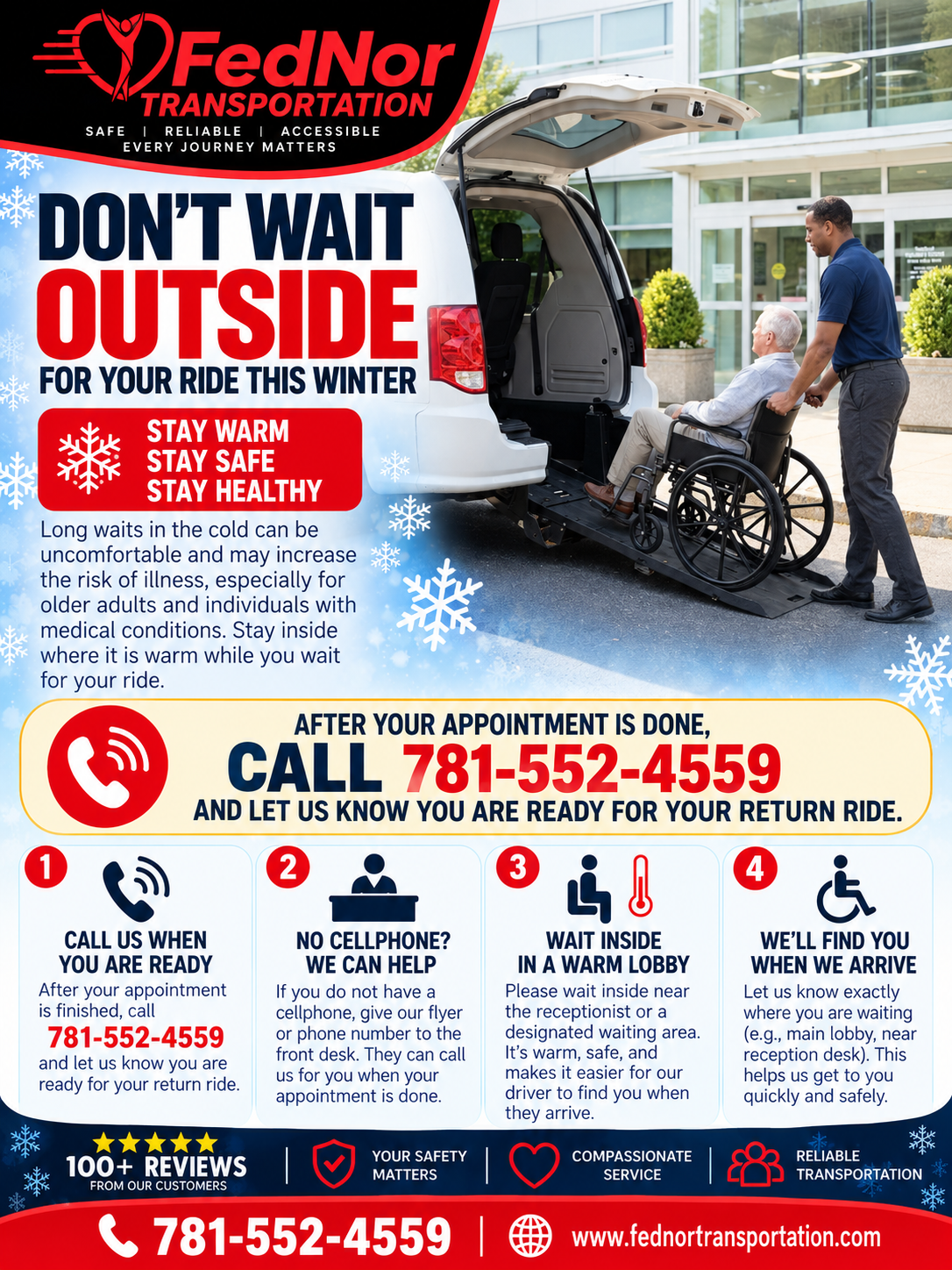
Key takeaway
A cold parking lot is not the place to wait for your ride. Learn will-call steps, lobby waiting, and winter pickup planning for wheelchair transportation.
When temperatures start dropping in Massachusetts, a transportation delay that might feel like a minor inconvenience in the summer can become a real problem in the winter.
This is especially important for older adults, wheelchair users, and patients returning from medical appointments. If your appointment is finished but your ride has not arrived yet, you do not need to sit outside in the cold waiting for the vehicle.
The better plan is simple: stay inside, stay warm, make sure your transportation provider knows you are ready, and wait somewhere the driver can easily find you.
That small amount of planning can make the trip home much safer and much less stressful.
Why Waiting Outside in Cold Weather Is a Bad Idea
It does not have to be below freezing for cold exposure to become a concern.
The CDC says hypothermia can occur even when temperatures are above 40°F if someone becomes chilled from rain, sweat, or cold water. Older adults are among the groups at increased risk from cold exposure.
That does not mean that simply being outside below 40°F will make someone sick. Cold weather itself does not cause viral infections such as a cold or flu. The concern is unnecessary cold exposure, particularly for someone who may already be older, medically vulnerable, wet, tired, or unable to move around easily to stay warm.
For someone sitting in a wheelchair, waiting outside can be particularly uncomfortable because the person may remain relatively still for the entire wait.
There is usually a better option.
Wait inside until your ride arrives.
Your Appointment Is Finished. What Should You Do?
If you have a scheduled return pickup, follow the instructions provided by your transportation company.
If your return trip is a will call, the process is different.
A will call means the exact return time was not known when the trip was scheduled. Once the appointment is finished, someone needs to notify the appropriate transportation contact that you are ready for your return ride.
Transportation programs that use will call trips generally work the same way: the passenger or the person responsible for them contacts the transportation provider after the appointment ends, and the wait can be 60 minutes or longer.
MassHealth explains this same basic process for its PT 1 transportation program. For a MassHealth will call trip, the member contacts the broker after the appointment ends, and MassHealth advises that the wait can be 60 minutes or longer. Massachusetts Government
The exact procedure and wait time will depend on your transportation arrangement. Do not assume your driver automatically knows that your appointment ended.
That is one of the most important things patients should understand about will call transportation.
If You Don't Have a Cellphone, Make a Plan Before Your Appointment
Not everyone has a cellphone.
That should not mean you have to walk or roll outside and hope your driver eventually appears.
Before leaving for the appointment, write down the transportation provider's name and telephone number. Better yet, keep the company's business card or transportation flyer with you.
When you check in for your appointment, you can tell the front desk: "I have a will call ride home. When my appointment is finished, I may need help calling my transportation provider."
Then, when your appointment is over, ask the receptionist or another appropriate staff member whether they can help you place the call.
For facilities that regularly work with wheelchair transportation companies, keeping the provider's flyer or contact information at the front desk can make this much easier.
The goal is simple. Someone needs to communicate that the passenger is ready.
Give the Front Desk Your Transportation Information
This is something families, caregivers, facilities, and transportation companies can work together on.
If you regularly use the same transportation provider, ask whether they have business cards or flyers you can keep with your paperwork.
When you arrive at the doctor's office, rehabilitation center, dialysis center, hospital clinic, or another facility, the front desk can have the transportation company's contact information available if you need assistance.
This is particularly useful for patients who do not carry a cellphone or who may have difficulty making calls independently.
It can also prevent a frustrating situation where the patient is finished with an appointment, the transportation provider has not been notified, and everyone assumes somebody else made the call.
Wait in the Lobby, Not Outside
After your transportation provider has been notified, find an indoor location where you can comfortably wait.
In many facilities, the main lobby or an area near reception may be the most practical location, if the facility permits it.
There are two reasons.
- You can remain indoors where it is warm.
- You are easier to locate when the driver arrives.
Tell the transportation company exactly where you will be waiting. For example: "I'm finished with my appointment. I'm inside the main lobby next to the reception desk, seated in my wheelchair."
That is much more useful to a driver than simply saying, "I'm ready."
Large hospitals and medical buildings can have several entrances. There may be a main lobby, emergency entrance, outpatient entrance, medical office entrance, rehabilitation entrance, or multiple buildings at the same address.
Make the pickup location clear.
Don't Go Outside Just Because You Think the Driver Is Close
This is where patients sometimes make an understandable mistake.
You receive a call saying the driver is on the way, so you immediately go outside.
Then traffic happens.
- The driver has difficulty finding the correct entrance.
- Another passenger takes longer than expected.
- The pickup lane is congested.
- Or the vehicle is still several minutes away.
Now you are sitting outside in 35°F weather waiting.
Instead, whenever the facility allows it, remain indoors until the vehicle has actually arrived at the correct pickup location.
The driver can call when they arrive. If you do not have a cellphone, discuss another communication plan beforehand. Depending on the facility, the driver may be able to identify you at the agreed pickup area or communicate with reception.
The exact arrangement should be confirmed with your transportation provider and the facility rather than assumed.
Pick One Clear Meeting Point
Winter transportation works much better when everyone knows exactly where the passenger will be.
Before the appointment, identify the pickup point.
- It could be the main lobby.
- It could be the outpatient entrance.
- It could be a designated patient transportation area.
- It could be another accessible entrance required by the facility.
Whatever location is chosen, make sure the patient, caregiver, front desk, dispatcher, and driver have the same information.
For wheelchair passengers, also make sure the route from the waiting area to the vehicle is accessible.
Dress for Winter Even If You Expect to Wait Indoors
Waiting inside does not eliminate the need to prepare for winter weather.
You still need to travel between the building and vehicle.
The CDC recommends appropriate winter clothing during cold weather, including layers, a hat, gloves or mittens, and water resistant outerwear and footwear when conditions require it.
Wheelchair users should pay particular attention to exposed hands, feet, legs, ears, and other areas that may become cold.
Bring whatever winter clothing is appropriate for the day's conditions even if you expect the vehicle to be waiting when you leave.
Massachusetts weather and traffic do not always cooperate with the schedule.
Caregivers Should Plan the Return Trip Before Leaving Home
If you are arranging transportation for a parent, grandparent, nursing home resident, or another person who needs assistance, don't only plan how they will get to the appointment.
Plan how they will get home.
Before the trip, confirm:
- Whether the return ride has a scheduled pickup time or is will call.
- Who needs to be contacted when the appointment ends.
- Who will make that call if the passenger does not have a cellphone.
- Where the passenger will wait inside.
- Which entrance the driver should use.
- Whether the passenger will need assistance getting from the lobby to the vehicle.
- Whether a caregiver or escort will be traveling with the passenger.
That five minute conversation before the appointment can prevent a long and uncomfortable wait afterward.
Medical Offices Can Help Too
Front desk teams and medical facilities play an important role.
If your office regularly sees patients arriving by wheelchair van, non emergency medical transportation, senior transportation, or other assisted transportation, consider having a clear process for patients waiting for their return rides.
When appropriate under facility policy, allowing a wheelchair passenger to remain near reception or another designated indoor waiting area can give the passenger a warm place to wait while also making the pickup process easier.
Transportation providers can help by leaving current contact information with facilities they serve regularly.
A simple flyer at the front desk can make a difference.
It gives staff a number to call when a patient needs assistance contacting the transportation company.
Will Call Does Not Mean the Vehicle Is Already Outside
This deserves repeating.
A will call return trip generally means the passenger or responsible party initiates the return process when the appointment is finished.
Many transportation programs advise that will call passengers contact their provider after the appointment, and the wait may be 60 minutes or longer.
Other transportation programs and private providers may operate differently.
That is why patients should ask before their trip: "When my appointment is finished, who exactly do I call?"
Write the answer down.
If You Know When the Appointment Will End, Consider a Scheduled Return
Not every trip needs to be will call.
If the appointment has a fairly predictable ending time, ask your transportation provider whether scheduling a return pickup makes more sense.
Many providers advise that passengers who are uncertain about appointment length can add additional time to the expected pickup or use a will call. Some passengers find it easier to schedule the return later than the expected appointment ending so they have a clearer idea of the waiting period.
There are tradeoffs either way.
- An appointment may run late.
- A scheduled vehicle may encounter traffic.
- A will call may involve a wait.
The important thing is knowing which type of return trip you have before you leave home.
Know the Warning Signs of Dangerous Cold Exposure
If someone has been exposed to cold weather and develops significant shivering, exhaustion, confusion, fumbling hands, memory problems, slurred speech, or unusual drowsiness, those can be warning signs of hypothermia.
The CDC identifies hypothermia as a medical emergency and advises seeking medical attention when signs are present. A body temperature below 95°F requires immediate medical attention.
Transportation convenience becomes secondary at that point.
Get the person somewhere warm and seek appropriate medical assistance.
A Better Winter Routine for Wheelchair Transportation
Winter transportation does not have to mean sitting outside watching every vehicle that enters the parking lot.
A better routine is straightforward.
- Finish your appointment.
- Notify your transportation provider.
- Tell them exactly where you are.
- Stay inside in a warm designated waiting area.
- Keep your winter clothing with you.
- Move outside only when your transportation has actually arrived or according to the pickup procedure arranged with your provider and facility.
If you do not have a cellphone, plan for that before the appointment.
Bring your transportation company's flyer or phone number.
Ask the front desk whether they can assist you with the call when your appointment is finished.
And make sure everyone knows where you will be waiting.
For Medical Offices, Rehabilitation Centers and Facilities
FedNor Transportation encourages facilities coordinating transportation for wheelchair passengers to keep our contact information accessible to staff and patients.
A FedNor flyer at the reception desk can give patients and staff a clear point of contact when transportation has been arranged directly with FedNor.
For patients without a cellphone, having that information available can be especially helpful when the appointment ends.
Our goal is simple.
We don't want a passenger sitting outside in the Massachusetts cold unnecessarily waiting for us.
Stay inside where it is warm. Let us know you are ready. Tell us where you are waiting. When the driver arrives, we can coordinate the pickup.
Planning a Winter Wheelchair Trip With FedNor Transportation
FedNor Transportation provides wheelchair accessible transportation and other non emergency transportation services in Massachusetts.
If you are scheduling a winter medical appointment, let us know about the passenger's mobility needs, wheelchair type, pickup location, destination, appointment time, return arrangement, and any assistance needed.
If the return is arranged as a will call directly through FedNor, make sure you understand the contact procedure before the trip.
Patients without a cellphone should consider bringing FedNor's contact information and discussing their return transportation with the medical office when they arrive.
To arrange a winter trip, call FedNor Transportation at 781-552-4559 or send a request through our ride request page.
Need a ride you can trust?
FedNor Transportation provides safe, dignified non-emergency medical transportation across MetroWest Massachusetts.